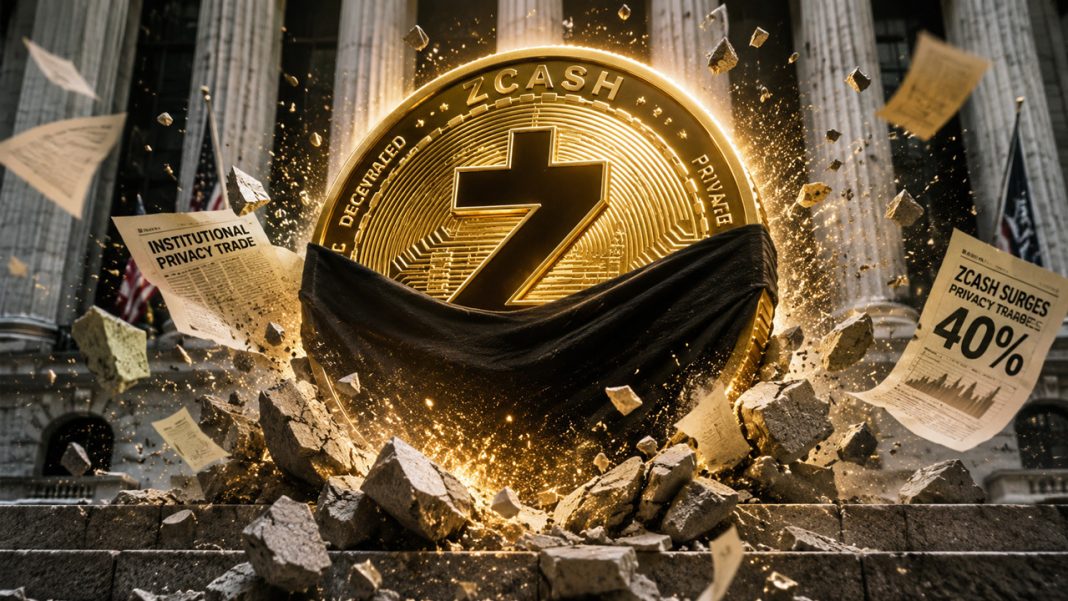


Zcash is rapidly shedding its historical reputation as a niche tool for digital anonymity, transforming instead into a high-stakes institutional hedge against global financial surveillance.
According to CryptoSlate’s data, the privacy-centric cryptocurrency rocketed roughly 40% in a single trading session on Wednesday, briefly eclipsing the $600 mark to hit a local peak of $603 before settling near $570.
The explosive intraday move extends a staggering period of outperformance for the digital asset, which has now soared more than 100% over the past month.
Arjun Chirumamilla, an investor at HashGraph Ventures, observed that the current momentum stems from long-term fundamentals surrounding the digital asset rather than short-term manipulation.
He stated:
“You can coordinate pumps… but they never last. You can’t coordinate real tailwinds. When they converge, they become bigger than any one person and persist for years. That’s what’s happening with Zcash: a decade of quiet consolidation, and the convergence of privacy and quantum resistance.”
Wall Street embraces cypherpunk ideals
Zcash has long occupied a specific corner of crypto. It was built as a Bitcoin-like monetary network with privacy features that can shield transaction details, including sender, receiver, and amount.
That design made it popular among privacy advocates but also kept it under regulatory scrutiny and away from the institutional flows that helped lift Bitcoin and Ethereum.
That split is now narrowing.
Bitcoin’s public ledger helped institutions gain comfort with blockchain settlement, custody, and supply transparency.
Meanwhile, it also showed the limits of open financial networks because wallet balances, transaction histories, and counterparties can be traced with growing precision, especially as blockchain analytics firms, governments, and artificial intelligence tools make public ledgers easier to monitor.
Zcash’s supporters argue that this transparency creates a separate market for private digital money. In that framing, Bitcoin remains the dominant store-of-value asset, while Zcash becomes a way to express demand for confidentiality in payments, balances, and financial relationships.
Considering the above, that argument has started to move into public markets, with the immediate catalyst for Wednesday’s massive green candle being a disclosure from Multicoin Capital. The prominent crypto investment firm announced it had amassed a formidable position in the privacy token.
Tushar Jain, Multicoin’s managing partner and co-founder, argued that Zcash stands to benefit from a market that is starved of censorship-resistant vehicles, citing aggressive tax policies and the wealth-seizure proposals in California.
He wrote:
“As the political trend to seize private wealth continues to grow, people and institutions will increasingly seek private assets to protect themselves.”
Jain furthered that Zcash represents the most pristine public-market vehicle to capture this accelerating demand, saying:
“I used to think privacy only mattered for payments, not for SoV. Payments will be in stables so I thought private stables were the solution. I still think privacy matters for payments but now I think that privacy also matters for SoV due to wealth taxes. And no intelligent investor is using fiat pegged stablecoins as a SoV so you need a private and scarce SoV. ZEC has a credible shot at being the main private SoV.”
That sentiment is also being echoed by Cypherpunk Technologies, an enterprise backed by Gemini co-founder Tyler Winklevoss, which has leaned aggressively into the privacy narrative.
Over the past year, the company has methodically accumulated nearly 295,000 ZEC tokens, representing 1.78% of the asset’s circulating supply, with a stated objective of ultimately cornering 5% of the network.
Will McEvoy, the chief investment officer at Cypherpunk, articulated a clear dichotomy between the world’s top two digital assets: if Bitcoin represents an innovation in digital gold, Zcash is its equivalent for private digital cash.
McEvoy warned that the integration of artificial intelligence into everyday commerce will hyper-charge corporate and state surveillance, making transparent ledgers a liability for everyday transactions.
In this world where spending habits seamlessly reveal personal routines, vulnerabilities, and associations, McEvoy argues that an encrypted-by-default monetary layer will be the only bulwark against digital coercion.
Leverage fuels ZEC upside
Beyond philosophical shifts, Zcash’s parabolic trajectory is being fueled by sheer market mechanics. A confluence of new demand and artificially restricted supply has created a powder keg for short sellers.
Data from CoinGlass showed that Zcash’s open interest climbed above $1 billion, while derivatives trading volume rose to more than $7 billion over 24 hours.
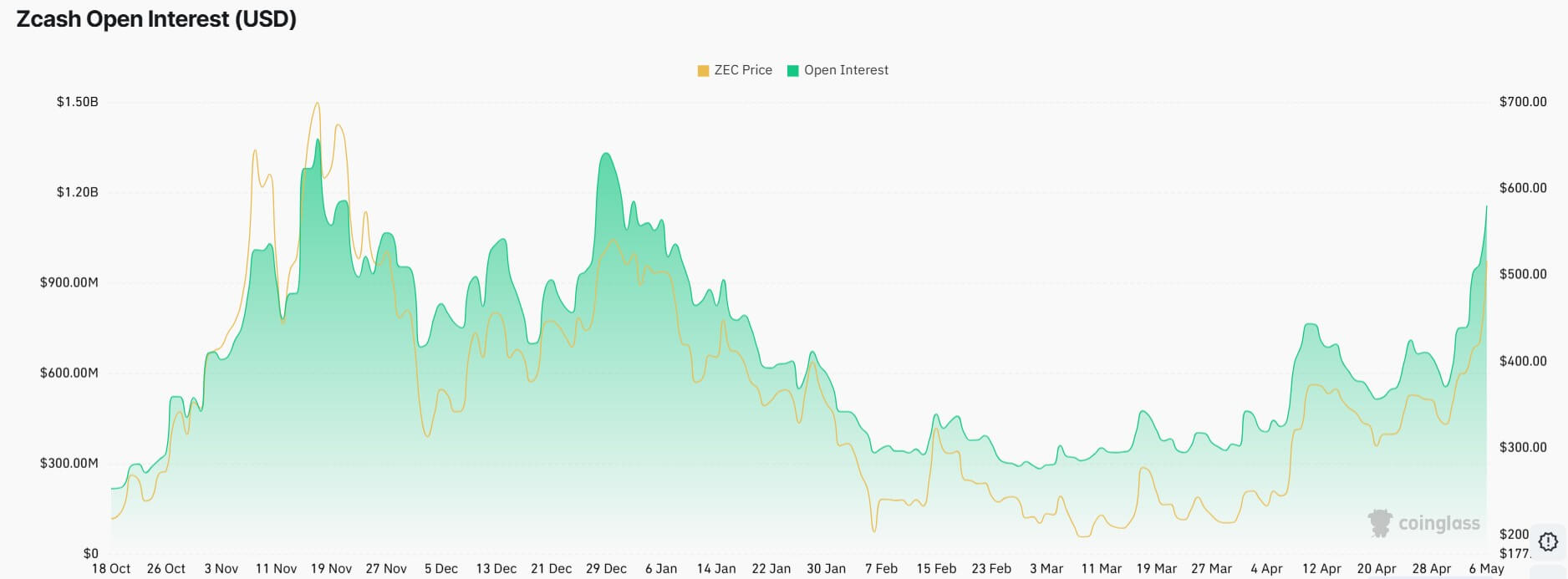
At the same time, the privacy coin surge triggered about $62 million in futures liquidations, with short sellers accounting for most of the forced exits.
That turned a narrative rally into a mechanical squeeze as new buyers entered the market after Multicoin’s disclosure and renewed ETF speculation.
So, as ZEC broke higher, short sellers were forced to buy back positions, adding more upward pressure. Momentum traders then chased the move, pushing Zcash into the ranks of the session’s most heavily traded crypto assets.
Meanwhile, the setup was especially powerful because Zcash has a lower market capitalization and a smaller available float than Bitcoin or Ethereum.
Moreover, a meaningful share of its supply is held in shielded addresses, while a growing portion of network activity uses Zcash’s privacy pool.
Thus, market bulls argue that this reduces the amount of ZEC readily available on exchanges, making the token more sensitive to fresh demand.
What is next for Zcash’s price?
Looking ahead, market analysts are sketching out aggressive long-term price targets based on the assumption that Zcash will capture an increasing slice of the broader digital currency sector. The underlying thesis driving these projections is a widespread belief regarding the nature of digital anonymity.
Barry Silbert, the Chairman of Grayscale, highlighted this shifting paradigm by pointing to the market’s historical blind spots.
He noted that back in 2015, early adopters fundamentally misunderstood the flagship cryptocurrency, assuming Bitcoin offered a fully private way to store and transfer global value. Now that the absolute transparency of public blockchains is universally recognized, Silbert argues that Zcash stands to benefit directly as investors seek the confidentiality they originally expected from digital assets.
Notably, Grayscale’s internal projections suggest immense upside potential if this capital rotation accelerates. The asset manager emphasized that ZEC’s current valuation represents a minuscule 0.3% of the broader currency-focused crypto sector.
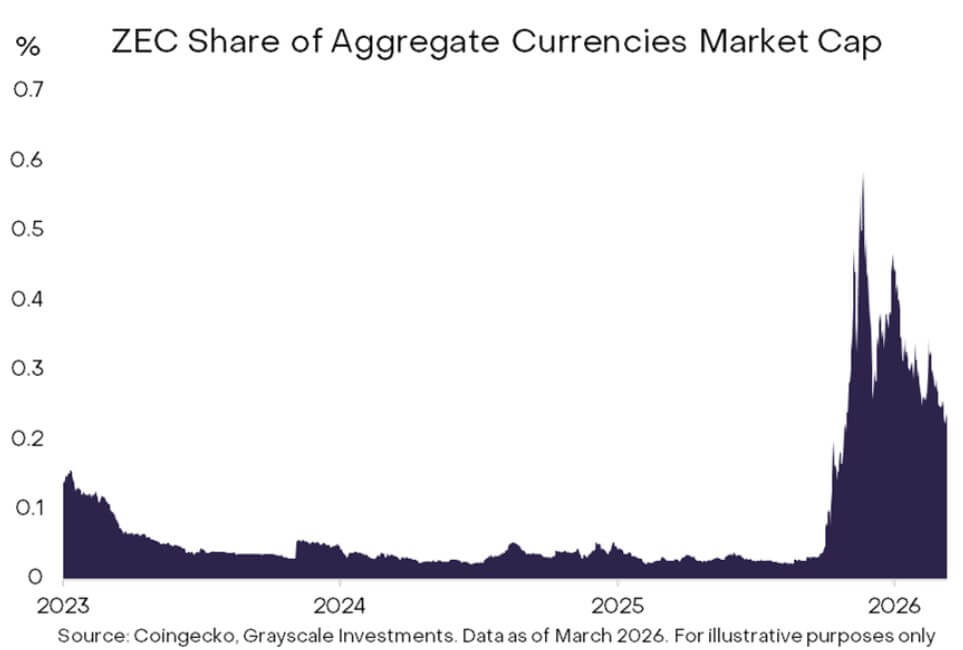
Should the privacy network capture even a modest 5% of this specific market segment, it would translate to an 18-fold increase in the token’s total value. However, the firm maintains the caveat that Zcash, as a lower-cap asset, carries an inherently higher volatility and risk profile than market leaders.
Meanwhile, other prominent industry veterans are mapping out even more ambitious trajectories. BitMEX co-founder Arthur Hayes has publicly outlined a structural target where Zcash ultimately commands 10% of Bitcoin’s total market capitalization.
If these institutional forecasts prove accurate, the recent price explosion is not an anomaly, but the opening salvo of a historic repricing event for digital financial privacy.
Crypto,Market,Price Watch,Privacy,TradFi,Trading,Bitcoin,ZCash,ZECBitcoin,ZCash,ZEC#Zcash #exploded #privacy #coin #rally #longer #cryptonative #trade1778159589