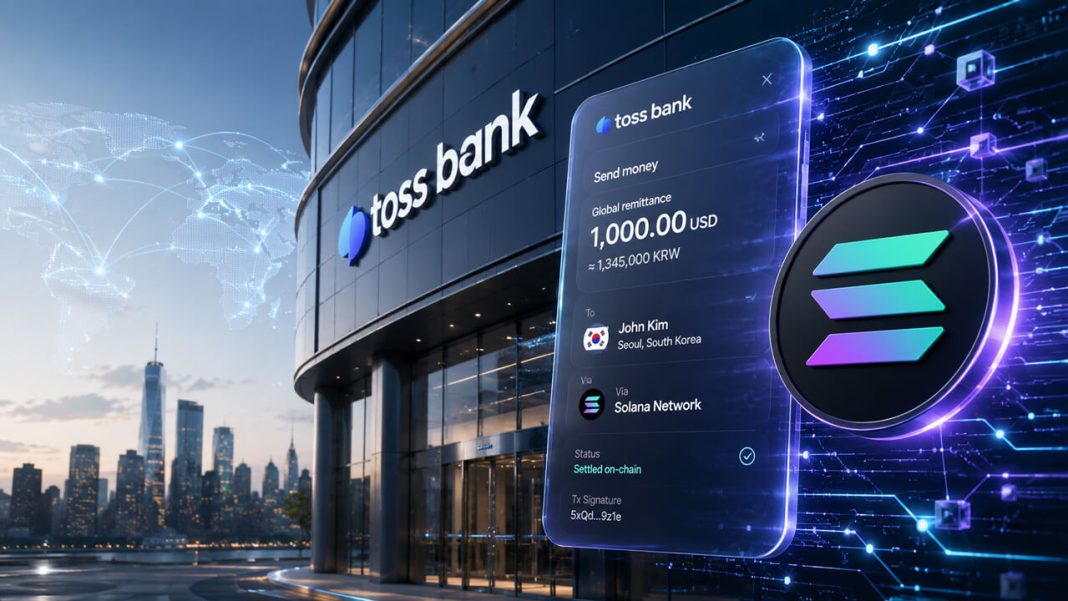
Toss Bank’s Solana proof of concept would put stablecoin remittance infrastructure beside a regulated bank app used by millions of customers.
In a June 22 post, Solana said South Korea’s Toss Bank is set to use the network for a global remittance and settlement PoC. Local reporting said Toss Bank signed a memorandum of understanding with the Solana Foundation to explore blockchain-based financial infrastructure.
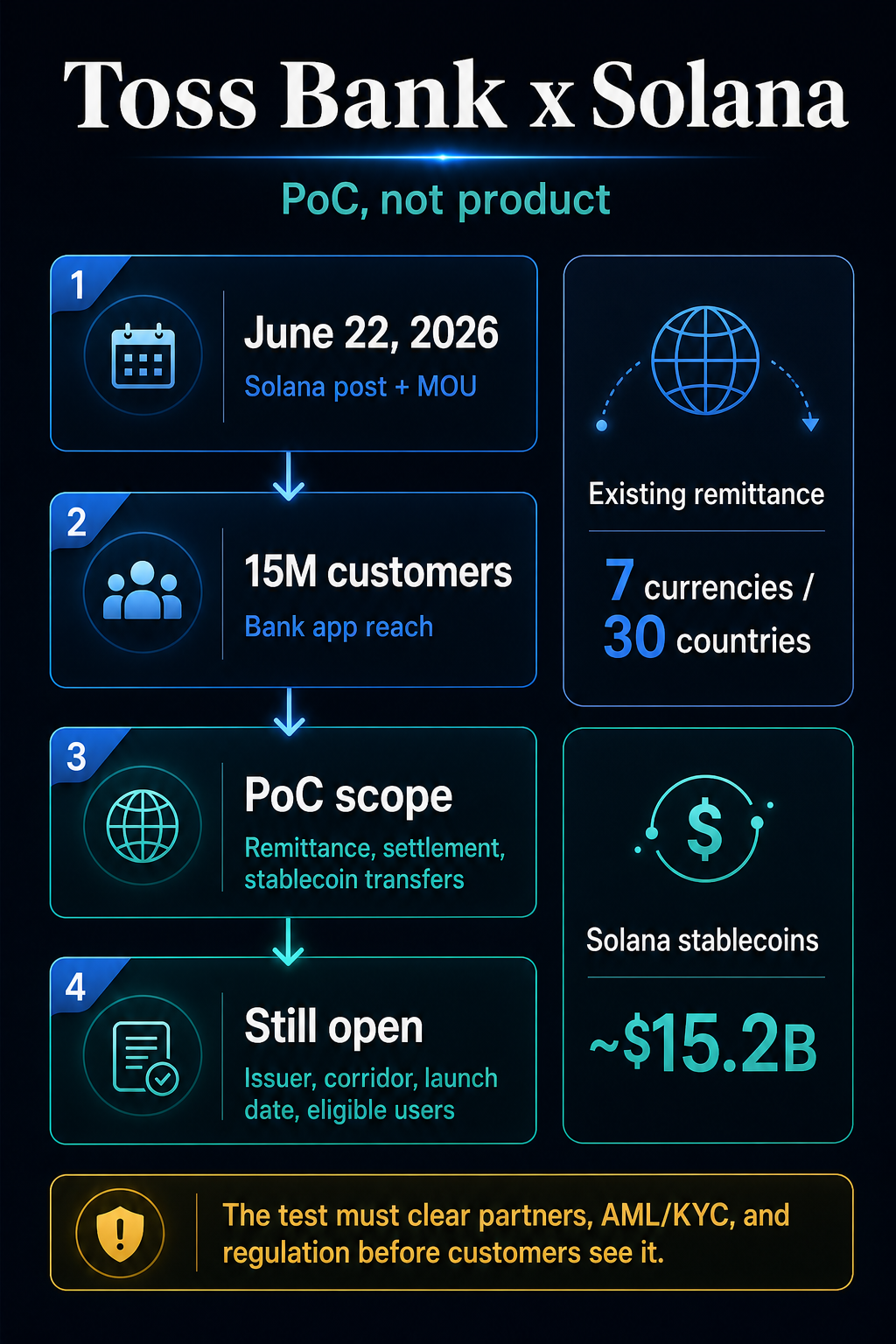
The announcement is an infrastructure test rather than a live consumer feature. The open details include launch timing, corridor, stablecoin issuer, token, custody model, and eligible users.
The announcement has since drawn broader attention across the crypto industry because it places a public blockchain inside a remittance experiment run by a regulated bank rather than a crypto-native payments company. That’s central to the test, but can blockchain settlement improve an existing banking product while keeping the customer experience within a familiar, regulated application?
Toss Bank became the first South Korean internet-only bank to partner with the organization behind Solana, according to The Korea Herald.
The agreement covers a phased proof of concept for international remittances, evaluation of blockchain-based payment and settlement systems, and exploration of services involving stablecoins and digital assets.
The bank keeps the customer relationship
The partnership is a test of where stablecoin remittance infrastructure could sit. A wallet-led model asks users to move into a crypto-native interface. A bank-led model could keep the customer within the financial app they already use, while public-chain settlement runs behind the product.
For Toss Bank, the practical consequence is control over onboarding, compliance, support, and product packaging. If the PoC advances, the bank could explore faster or cheaper settlement while keeping that customer relationship in-house.

If the work stops at the test stage, the impact for ordinary remittance customers remains limited.
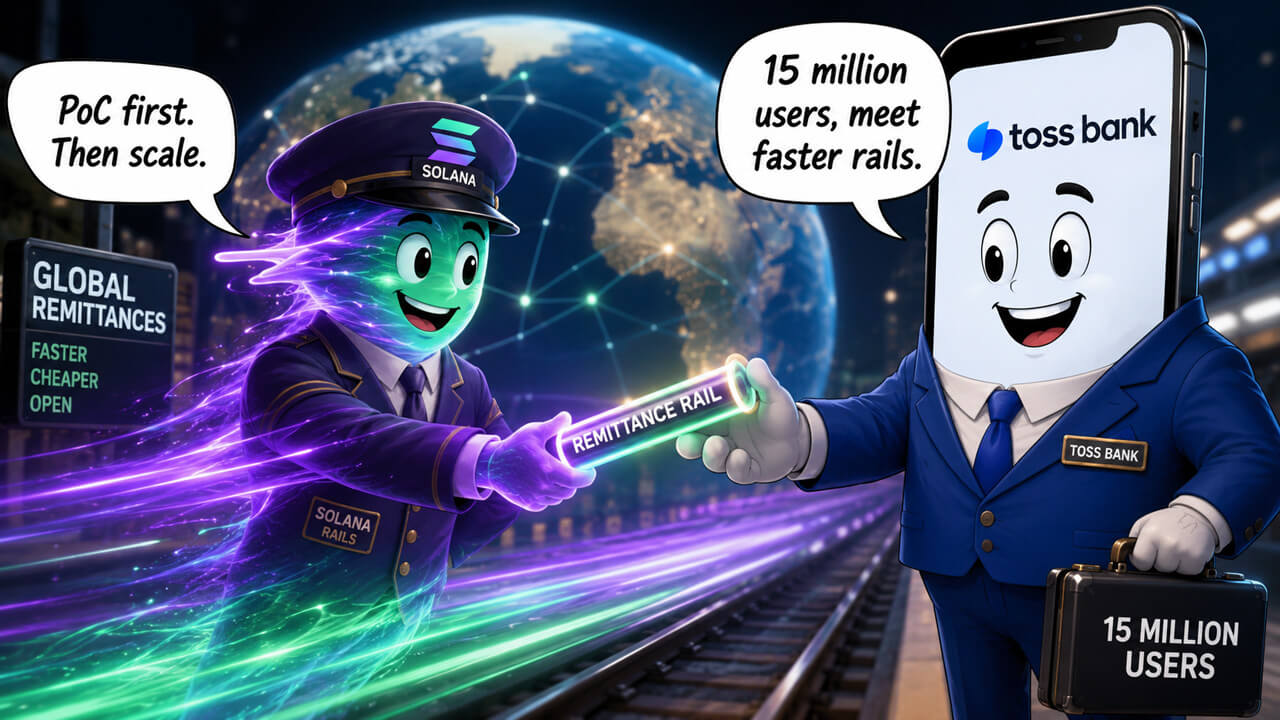
Solana framed the opportunity around Toss Bank’s reach, saying the bank has roughly 15 million customers. Recent Korean financial reporting places the bank’s customer base at that level, making it one of the country’s largest digital banking platforms.
For now, the scale claim means distribution, not rollout. The PoC is attached to a bank with that reach, giving the test a different weight than a remittance experiment run only through a standalone crypto app.
For now, the scale claim means distribution, not rollout. The PoC is attached to a bank with that reach, giving the test a different weight than a remittance experiment run only through a standalone crypto app.
Toss also has an existing cross-border product for comparison. The Korea Herald reported that Toss Bank launched its international remittance service in January, supports seven major currencies across 30 countries, and offers near-real-time transfers and tracking for selected currencies, including the euro, Singapore dollar, and British pound.
Toss Bank’s overseas transfer page presents the live service as fiat bank transfers.
That baseline raises the bar for the PoC. Blockchain settlement has to improve something concrete within an existing service: settlement cost, speed, corridor coverage, partner reach, or operational reliability.
A fast chain by itself is only one ingredient. The bank still has to fit that infrastructure into a regulated remittance product.
Park Jin-hyun, Toss Bank’s head of strategy, said the partnership was a first step toward integrating blockchain-based digital infrastructure into existing financial services, according to The Korea Herald. Solana Foundation President Lily Liu said the collaboration could help set new standards for international remittances by combining the trust of traditional finance with the efficiency of blockchain technology.
What has to clear before customers see it
The initial phase will test the technical feasibility of stablecoin transfers on Solana, according to The Korea Herald. ETNews also described the work as a phased Solana-based stablecoin remittance test, with later stages expected to involve overseas partners and compliance checks, such as anti-money-laundering and know-your-customer procedures.

The sequence is crucial. Technical feasibility comes first. Partner integration, compliance design, customer eligibility, and live product decisions come later.
That order keeps the announcement from becoming a launch claim before the hard parts are visible.
| Confirmed | Still undisclosed |
|---|---|
| Toss Bank and the Solana Foundation have an MOU covering blockchain-based financial infrastructure. | No retail launch date has been disclosed. |
| The PoC includes international remittance, payment and settlement systems, and stablecoin or digital-asset-linked services. | No specific stablecoin issuer, token, custody model, or settlement corridor has been named. |
| The first phase focuses on technical feasibility for stablecoin transfers on Solana. | No source says Toss Bank customers can already send Solana-based stablecoin remittances. |
| Later stages may include overseas partners and AML/KYC review. | No source identifies which customers would be eligible if the test advances. |
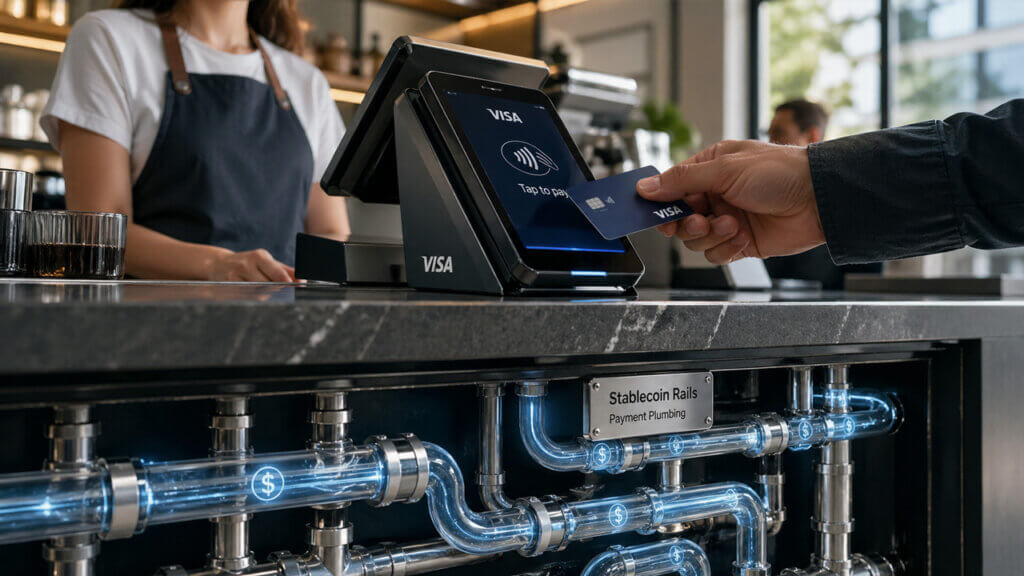
Solana already has substantial stablecoin activity to support the infrastructure argument. Current DeFiLlama data shows tens of billions of dollars in stablecoins circulating on the network, with USDC accounting for the largest share.
That market depth helps explain why a bank would evaluate Solana for settlement experiments, even though liquidity alone does not determine whether a remittance product succeeds.
That market depth can help explain why a bank would look at the network for settlement experiments.
A remittance product still needs cash-in and cash-out paths, partner institutions, customer screening, dispute handling, treasury procedures, and regulatory comfort in each relevant market. The chain can improve settlement mechanics, but the bank has to make the full product work across borders.
That is why the overseas partner language carries weight. Cross-border payments depend on institutions on both sides of a transfer.
If Toss Bank moves beyond a technical test, the next material disclosure will likely concern partners, corridors, or compliance design rather than a broader statement about blockchain efficiency.
Regulation sets the path from PoC to Solana stablecoin product
South Korea’s stablecoin policy environment remains a central constraint. Financial Services Commission materials in March discussed digital asset legislation and bank-centered stablecoin issuance, while a January FSC statement indicated that issuer details and the contents of the second-stage law had not been finalized.
That backdrop gives the Toss-Solana MOU a clear boundary. The agreement shows a bank exploring stablecoin-linked settlement infrastructure, while the regulatory path for Korean bank retail stablecoin remittances remains unresolved.
The compliance checks mentioned in the local reporting are central to the product question.
From here, the PoC has two paths. If technical feasibility, overseas partners, and AML/KYC controls align, Toss Bank could test whether stablecoin settlement improves its existing international remittance business while keeping the customer within a regulated app.
If issuer, corridor, partner, or regulatory details stall, the MOU remains an infrastructure experiment with limited customer impact.
The next signals are specific: the stablecoin issuer, the first corridor, partner banks or payment firms, custody treatment, compliance process, and whether Toss Bank adds any Solana-based option to its live remittance product.
Those details would show whether the PoC is moving from technical exploration toward something customers can actually use.
Toss Bank has positioned a public-chain settlement test alongside a mainstream digital bank’s remittance business. The bank-app test is the point: stablecoins are moving closer to regulated financial infrastructure, but the customer-facing version still depends on product, partner, and regulatory decisions that have yet to be disclosed.
Adoption,Featured,Stablecoins,Technology,Solana,Solana foundation,stablecoins,USDC,xrpSolana,Solana foundation,stablecoins,USDC,xrp#South #Korean #digital #bank #15M #users #turns #Solana #stablecoins #overseas #transfers1782259201