
Japan’s House of Councilors approved Cabinet Bill 57 by majority vote on July 15, completing Diet passage of legislation that will move regulated crypto activity into the Financial Instruments and Exchange Act.
The legal framework is now in place, but traders may still wait until 2027 or 2028 for the new market rules and 20% tax rate to take effect.
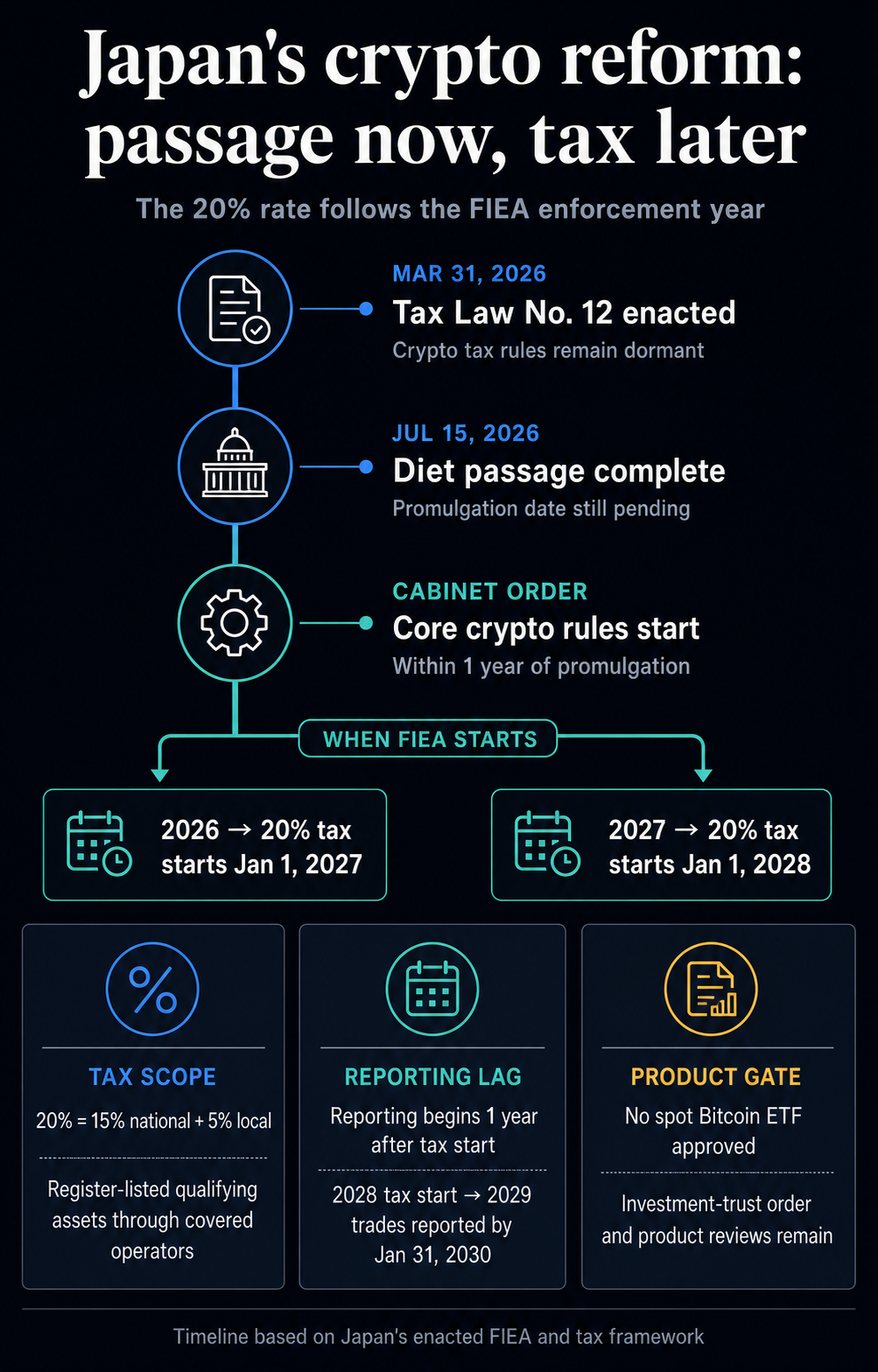
The official upper-house record says the core crypto provisions take effect on a date set by Cabinet order within one year of promulgation. Enforcement during 2026 would start the tax rules on Jan. 1, 2027; enforcement during 2027 would move that start to Jan. 1, 2028. The Cabinet’s timing will decide which calendar applies.
Implementation comes before the benefit
The reform shifts crypto transaction regulation out of the Payment Services Act and into FIEA. Crypto remains legally distinct from securities, but covered activity gains a securities-market-style compliance framework.
The Financial Services Agency’s explanatory materials add disclosure and registration coverage for crypto sales, issuer-controlled token offerings and borrowing, as well as asset screening, custody, customer safeguards, and insider-trading controls.
Exchanges and intermediaries can prepare for that framework now; its duties apply after commencement. Detailed operating requirements remain to be set by Cabinet orders and FSA ordinances.

Parliament has already enacted the tax side, but its crypto provisions remain dormant until the FIEA trigger is satisfied. Japan passed and promulgated the fiscal 2026 tax amendments as Law No. 12 on March 31. Once active, qualifying gains will be subject to a combined 20% rate, split between 15% national income tax and 5% local inhabitant tax.
The 20% rate applies only when investors sell eligible tokens through registered crypto businesses and the assets appear on Japan’s official register.
Unused losses within the same tax-defined crypto category can be carried forward for three years, subject to conditions. Tokens, venues and transactions outside that defined channel keep their existing treatment.
Reporting arrives a year after the tax-and-loss rules. Under the Ministry of Finance framework, businesses must provide tax authorities with customer identities, Japan’s My Number identifier, and transaction details by Jan. 31 after the trade year. If the 20% regime starts in 2028, reporting would cover transactions from 2029 and the first reports would be due Jan. 31, 2030.

The reform package also outlines a possible route for crypto investment products. It brings crypto investment management and advice within FIEA and anticipates certain investment trusts holding tax-qualifying, registered crypto assets. That treatment still requires a separate amendment to the Investment Trusts Act enforcement order.
The text names no spot Bitcoin ETF and grants no product approval. The FSA said in October 2025 that the formation and sale of domestic crypto ETFs were barred under the previous framework. Sponsors must still clear the applicable product and listing reviews after implementing rules define the new route.

The key dates now depend on when the law is formally enacted, when the Cabinet brings the FIEA changes into force, and when the FSA finishes the detailed rules. The 20% tax rate would then apply from the following tax year.
Featured,Market,Taxes,Trading,Bitcoin,BTC,ETF,payments,regulationBitcoin,BTC,ETF,payments,regulation#Japan #passes #crypto #law #traders #wanted #tax #wait1784238189