


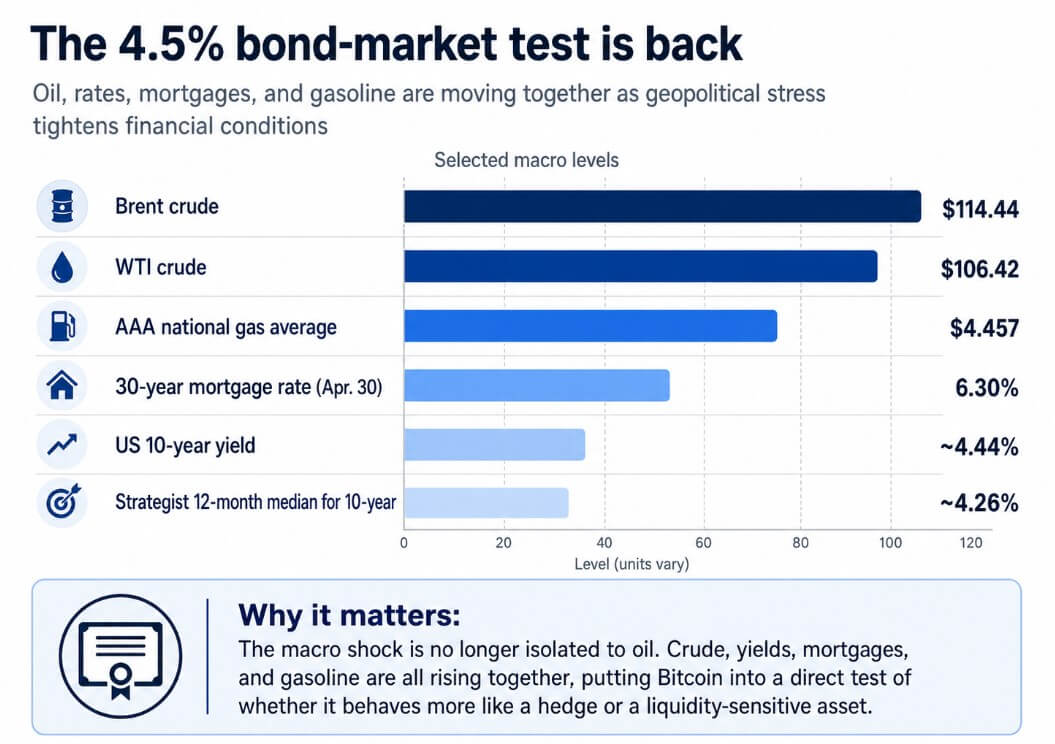
Iran’s attack on ships in the Strait of Hormuz and a drone strike on the Fujairah Oil Industry Zone sent Brent crude to $114.44 and WTI to $106.42, while the 10-year Treasury yield climbed to roughly 4.44% and the 30-year broke above 5%.
Bitcoin registered an intraday high of $80,717.66 on May 4, putting its macro identity to the test of being a hedge against monetary disorder or a liquidity-sensitive asset that struggles when yields rise, and cash becomes more attractive.
When the 10-year approaches 4.5%, mortgage rates, equity valuations, and corporate borrowing all tighten with it. Freddie Mac put the 30-year fixed mortgage at 6.30% as of Apr. 30, already up from 6.23% the week before.
When war-driven yield moves pushed the 10-year to 4.39% in late March, that mortgage rate jumped to 6.38% and climbed to 6.46% as escalation fears intensified in early April.
A poll of strategists had a median 12-month forecast for the 10-year yield of roughly 4.26%, and the market is already trading about 20 basis points above that level.
About 20% of global oil and LNG supply moves through the Strait of Hormuz, which is why the market reaction spread immediately from crude into rates.
Eurasia Group warned that without a deal to reopen the Strait of Hormuz, US gasoline could reach $5 a gallon, while AAA’s national average stood at $4.457 on May 4. Both numbers frame the inflation risk that feeds into rate expectations and complicates the Fed’s position.
The Fed problem
Barclays has moved its first expected Fed cut to March 2027, and CME FedWatch noted that traders see roughly a 78.7% probability of no rate change through the end of 2026.
Oil holding above $100 keeps inflation sticky enough that the Fed cannot use rate cuts to cushion risk assets, removing one of the cleaner tailwinds Bitcoin has benefited from in recent cycles.
Two forces are pushing long-end yields higher at once. The energy shock lifts inflation expectations, while the Treasury’s own borrowing calendar compounds the move. The Treasury now expects to borrow $189 billion in the second quarter and $671 billion in the third quarter.
More supply hitting a market already pricing in inflation risk keeps yields elevated even if the geopolitical premium fades, giving the bond selloff shelf life beyond any single Iran headline.
The IMF’s Kristalina Georgieva said on May 4 that the Fund’s adverse scenario is already in effect and warned oil could reach around $125 if the conflict extends into 2027.
Chevron’s CEO added that physical shortages would begin to appear, given that Hormuz handles a fifth of global crude.
The US is releasing up to 92.5 million barrels from the Strategic Petroleum Reserve as part of a broader IEA effort, but crude held its gains, and gasoline prices kept climbing. These numbers point to an insufficient policy response to remove the inflation premium from long rates.
| Driver | What the article says | Why it matters for rates |
|---|---|---|
| Oil shock | Iran-related escalation pushed Brent to $114.44 and WTI to $106.42 | Higher energy prices raise inflation expectations |
| Hormuz disruption | About 20% of global oil and LNG supply moves through the strait | Supply risk turns a geopolitical event into a macro inflation event |
| Fed on hold | Barclays moved its first expected cut to March 2027; FedWatch shows high odds of no change through end-2026 | The Fed has less room to cushion risk assets |
| Treasury borrowing | Treasury expects to borrow $189B in Q2 and $671B in Q3 | More supply puts added pressure on long-end yields |
| Policy response limits | US releasing up to 92.5M barrels from the SPR, but crude held gains | Markets are signaling the response may not be enough |
Bitcoin’s contradiction
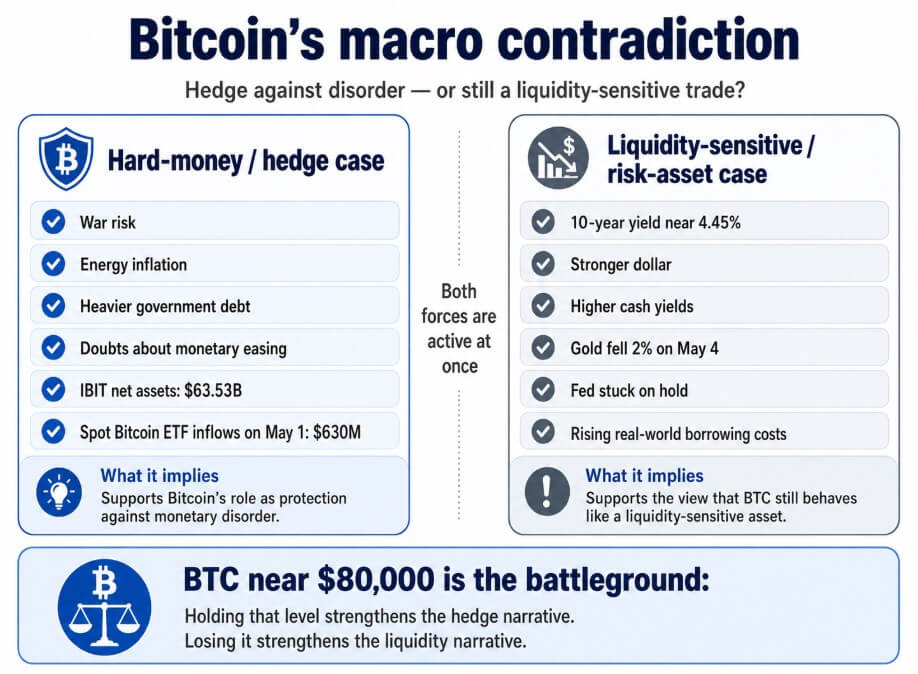
The hard-money case for Bitcoin strengthens the environment of war risk, energy inflation, heavier government debt, and doubts about monetary easing, all of which support the argument that fiat systems are becoming harder to manage and more expensive to run.
BlackRock’s IBIT held $63.53 billion in net assets as of May 1, and US-traded spot Bitcoin ETFs recorded $630 million in inflows that day. Institutional sponsorship at that scale reflects a durable view that Bitcoin belongs in portfolios exposed to macro disorder.
Gold’s behavior on May 4 complicates that picture, as even with Iran escalating and oil spiking, gold fell 2% as the dollar firmed and higher-rate expectations hardened.
A stronger dollar and more attractive cash yields can overpower the traditional hedge bid in the short run, and gold is the cleaner comparison because it carries no technology or adoption risk.
Bitcoin holding $80,000 despite a 10-year yield near 4.45% would confirm that institutional flows have made BTC less rate-sensitive. A breach of that level would reinforce the view that BTC still behaves as a liquidity-sensitive risk asset when real-world yields rise and the dollar firms.
What to expect
The bull case requires the geopolitical risk premium in oil to fade.
Shipping conditions improve, and Hormuz reopens to normal traffic, and yields drift back toward the median around 4.25%-4.30%.
In that setup, the institutional infrastructure already in place does the work, as IBIT’s scale and ETF inflows give Bitcoin a strong bid. The hard-money thesis survives the rate test, and the market reprices BTC toward its recent range without fighting an ongoing bond selloff.
Bitcoin’s structural buyer base of corporate treasuries, ETF flows, and sovereign-adjacent capital would have more room to accumulate at current levels.
The bear case plays out if oil stays near $110-$125, long yields break decisively above 4.5%, and the inflation premium in rates persists long enough for higher-for-longer Fed pricing to become the dominant market narrative through 2026.
In that environment, Bitcoin trades like a liquidity-sensitive asset, particularly if the dollar holds its gains and gold continues to give back its hedge premium.
The Treasury supply picture strengthens the bear argument, as even if tensions with Iran cool, $671 billion in third-quarter borrowing keeps upward force on the long end and narrows the window for a liquidity-driven Bitcoin rally.
Bitcoin’s long-run hard-money thesis survives a prolonged Fed hold, but holding $80,000 while the 10-year sits near 4.45% and oil trades above $100 requires the bond market to stop tightening financial conditions, or for institutional flows to be large enough to absorb the rate headwind.
Analysis,Featured,Macro,Market#IranUAE #escalation #pushes #Bitcoins #bondmarket #test #danger #zone1777972252