Bitcoin price broke lower overnight while regulators played their usual power games on two continents. Binance MiCA application in Greece reportedly hit a wall after Christine Lagarde, ECB president, allegedly leaned on authorities to block it. Meanwhile, Bybit has been added to the Singapore MAS Investor Alert.
Centralized infrastructure keeps eating friction while the market reroutes around it. Money isn’t waiting for permission slips; the pattern is obvious. Governments tighten the net on platforms they can reach, then act surprised when liquidity and users migrate to systems that don’t ask for approval. The contrast with traditional markets made the crypto reaction look more deliberate.
The biggest capital destruction in crypto happened inside heavily intermediated structures, not in the open protocols that actually survived the cycles.
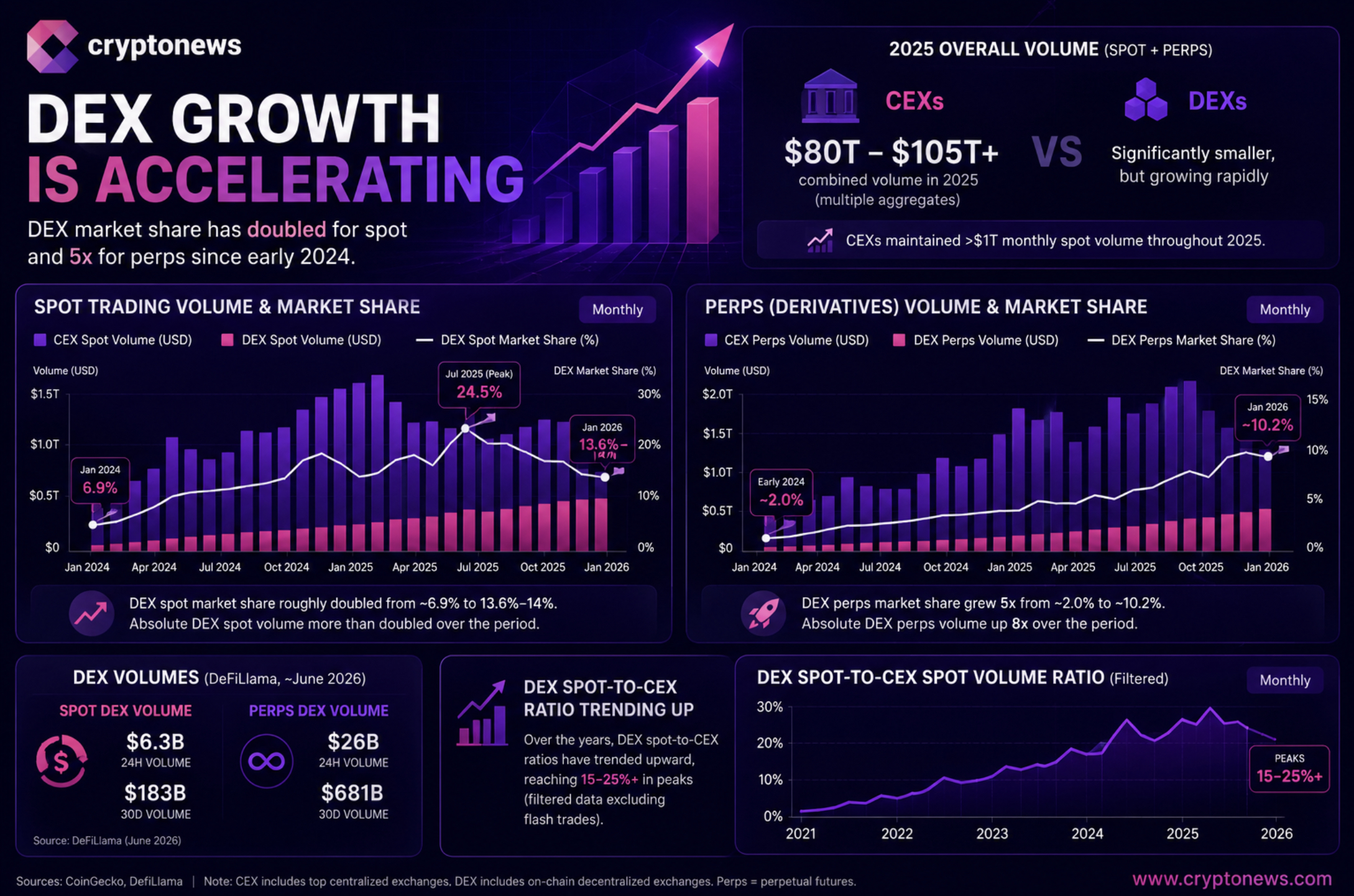
Looking at the illustration above, we can see that the numbers increasingly support the case for decentralized rails. While centralized exchanges still dominate with $80–105 trillion in annual trading volume, DEX adoption has accelerated at a rapid pace.
According to data from Coingecko and Defillama, DEX spot market share doubled from about 6.9% in early 2024 to 14% by early 2026, peaking above 24% during periods of bull run euphoria.
In derivatives, DEXs made even bigger gains, expanding their market share fivefold from around 2% to more than 10%, while absolute perpetual futures volume surged eight times. DEXes are steadily becoming a core layer of global crypto market infrastructure.
Discover: The Best Crypto to Diversify Your Portfolio
Bitcoin Price Slips on First Kevin Warsh’s FOMC
Bitcoin price slipped to $63,800 before bouncing back above $64,000, with Ethereum following into the red under $1,750. Hawkish comments from the new Fed chair on inflation expectations triggered liquidations, even as a reported Iran deal provided a short-term lift. ETF flows turned negative again, with combined Bitcoin and Ethereum products shedding over $100 million.

It’s not a secret that macro dictates short-term direction, especially in a bear market. Bitcoin remains trapped in the $60,000–$70,000 price range, and every time policy rhetoric hardens, risk assets test support first. What’s weird is how little the positive geopolitical headline is driving the sentiment at the moment.
Discover: The Best Token Presales
Binance, Bybit, MiCA, MAS, and ECB Lagarde’s Role in Greece
Fresh news claims that the Binance MiCA path through Greece was derailed in part by direct pressure from ECB Christine Lagarde. The Greek regulator had apparently cleared the technical review, yet the application stalled ahead of the July 1 deadline. France now sits as Binance’s remaining realistic route for EU-wide authorization under MiCA.
Regulators appear to be comfortably slowing a dominant private player while their own digital euro project continues development. Besides Binance and ECB drama, USDT’s ongoing non-compliance with MiCA has also shown another layer of selective enforcement. The tension, right or not, reveals the incentive of protecting monetary sovereignty first, then dressing it up as consumer protection.
As of now, Binance responded by reaffirming full compliance and warning that further delays would harm European liquidity and choice. The exchange is treating this as a logistics problem.
On the other hand, Bybit MAS inclusion shows the limits of centralized scale. Singapore’s Monetary Authority placed Bybit on its Investor Alert List yesterday as the platform lacks local licensing for users there. The Bybit MAS action lands at a sensitive moment as the global regulatory patchwork tightens, even with the exchange holding full MiCA compliance.
At the moment, centralized exchanges keep discovering that scale doesn’t buy immunity. Meanwhile, permissionless venues continue absorbing flow without needing to negotiate jurisdiction by jurisdiction.
The Bybit MAS episode is another point in the ongoing migration from platforms that require constant regulatory maintenance to infrastructure that doesn’t. The largest historical losses in crypto didn’t come from code exploits in decentralized systems. They came from concentrated custody failures and misaligned incentives inside entities that operated under varying degrees of oversight.
Open protocols have their own risks, but they lack the single point of capture that regulators can flip overnight. The current regulatory theater won’t slow the underlying shift. It simply makes the advantages of decentralized rails more obvious.
Remember, liquidity doesn’t disappear, and it always finds new paths.
Discover: The Best Crypto to Diversify Your Portfolio
The post Crypto News, June 18: Bitcoin Price Slid, ECB Allegedly Blocks Binance MiCA Application as Bybit Added to MAS Alert appeared first on Cryptonews.
News,Adoption,Bitcoin,Regulation#Crypto #News #June #Bitcoin #Price #Slid #ECB #Allegedly #Blocks #Binance #MiCA #Application #Bybit #Added #MAS #Alert1781778078