
Bitcoin mining pool Poolin Technology filed for Chapter 11 with $163.7 million in IOUs owed to wallet users. Its two Texas affiliates are seeking court approval for asset sales with opening offers worth $52 million.
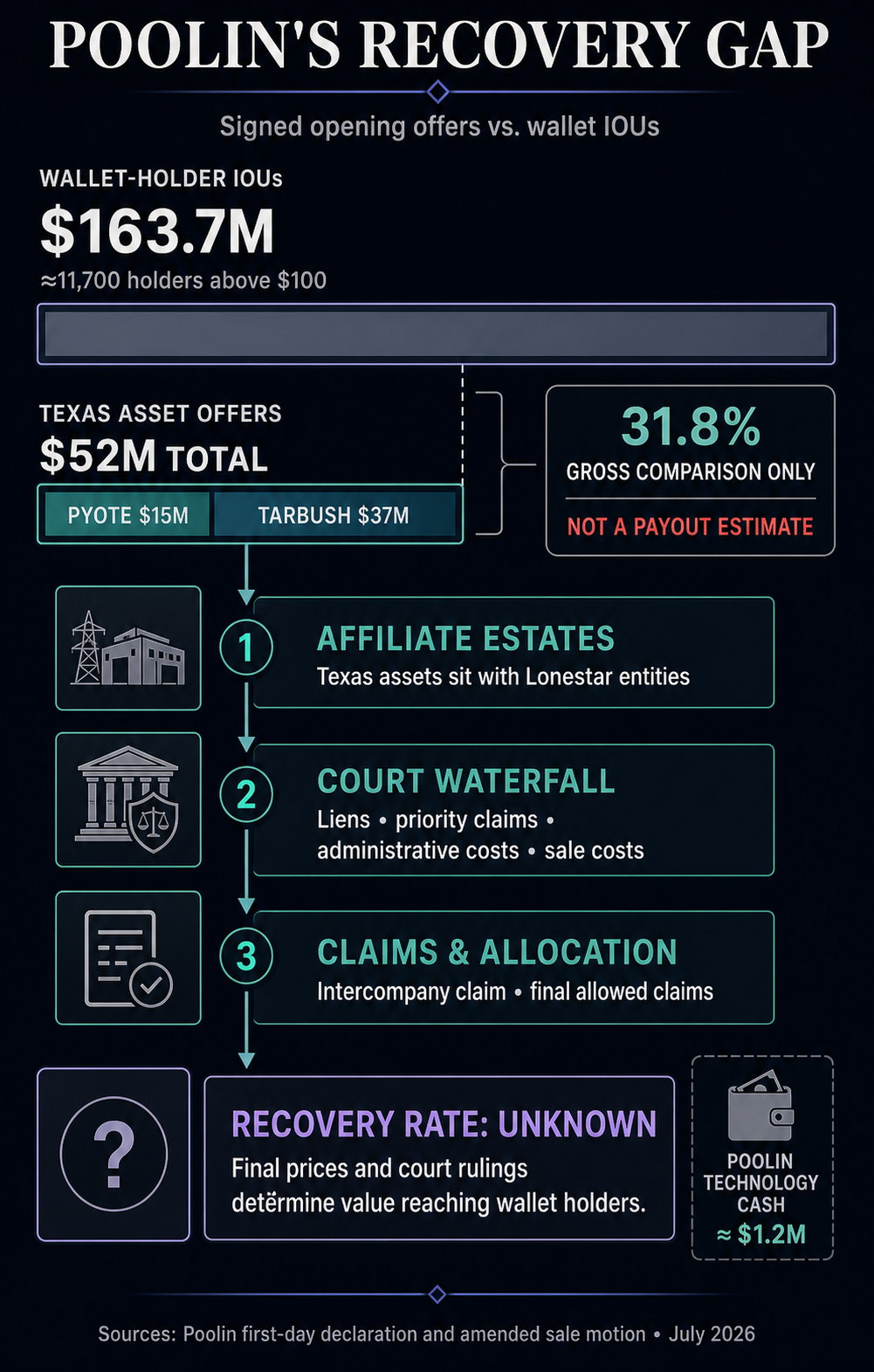
The offers equal about 31.8% of the IOUs, yet they cover assets held by Lonestar affiliates rather than cash in Poolin Technology’s wallet business. No reliable recovery estimate exists while the final sale prices, liens, estate allocations, bankruptcy expenses, and allowed claims remain unresolved.
An auction could draw bids from crypto miners and AI data-center operators, pushing the sale price higher. The money would then move through the bankruptcy court’s payment order before reaching Poolin Technology’s unsecured wallet creditors.
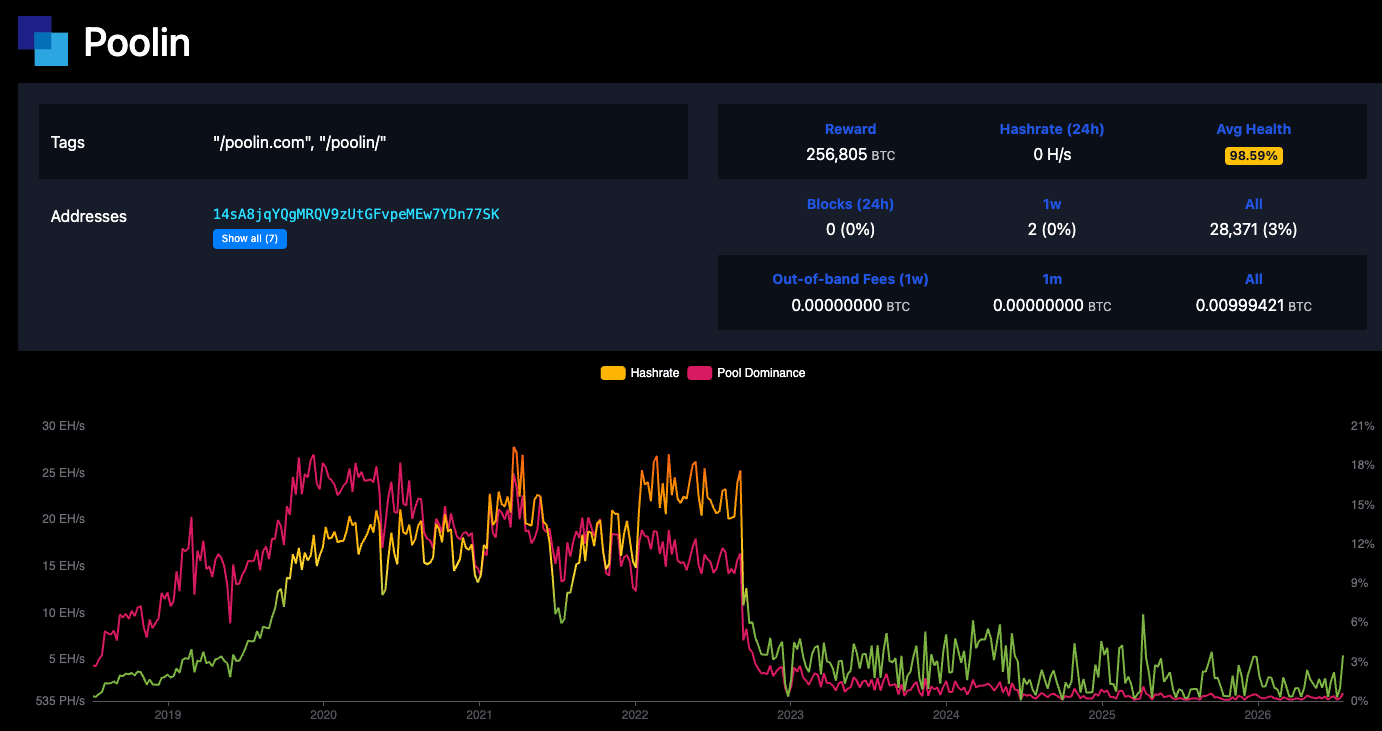
Poolin was once one of Bitcoin’s largest mining pools. Its hashrate climbed above 25 EH/s in 2021 and 2022, while its share of the network peaked near 18% around 2020. Addresses tagged to the pool have mined 28,371 blocks and earned 256,805 BTC in rewards.
Poolin Technology Pte. Ltd., Lonestar Taproot LLC and Lonestar Dream Inc. filed voluntary Chapter 11 petitions in the US Bankruptcy Court for the District of New Jersey on July 22. Their cases are being jointly administered under case 26-18325.
Poolin’s first-day declaration lists $163,723,500 of unsecured wallet-holder IOUs and $173,109,791 across its preliminary prepetition capital structure. Formal schedules and statements of financial affairs are still forthcoming.
What separates the $52 million from wallet holders
Prospective buyer Thor CALAP LLC signed a $15 million stalking-horse agreement for the Pyote assets and a separate $37 million agreement for Tarbush-related assets. The proposed transactions establish $52 million in aggregate opening consideration for substantially all of the covered Texas mining assets.
Poolin Technology itself reports about $1.2 million in a New Jersey bank account, an office lease and an intercompany claim. The Texas sites, power rights and equipment sit with the Lonestar affiliates. The filings identify those assets by debtor even though the three cases are jointly administered.
Poolin Technology’s claim against its affiliates may determine how much of the mining assets’ value reaches wallet creditors. The court has yet to decide what that claim is worth or how it will be handled.
The amended sale motion would transfer existing liens to the sale proceeds while preserving their validity and repayment priority. Administrative expenses, priority claims, sale costs, disputes and final claims reconciliation would further separate gross consideration from cash available for unsecured distributions.
A competing transaction could also bear the proposed bid protections. They include a 3% breakup fee for each stalking-horse agreement, plus expense reimbursement capped at $250,000 for Tarbush and $150,000 for Pyote. The motion seeks administrative-expense treatment for those protections, payable from the proceeds of a competing sale.
Poolin Technology and Lonestar Dream each estimate assets of $1 million to $10 million, while Taproot estimates $50 million to $100 million. Each debtor selects liabilities of $100 million to $500 million and 10,001 to 25,000 creditors.
Those broad, standardized ranges say little about what the group is worth as a whole. The declaration’s preliminary capital structure offers a clearer starting point, though upcoming schedules may change the picture.
How wallet lending and Texas losses consumed Poolin
The IOUs grew out of a wallet business that borrowed stablecoins against customers’ crypto. Poolin Wallet later offered deposit products promising annual returns of roughly 2% to 8.8%, according to the declaration.
When Bitcoin fell below $20,000 in June 2022, the pledged collateral lost value and triggered calls for more collateral. Poolin shifted its financing relationship to Antalpha Technologies, which lent against the digital assets. Poolin used financing proceeds for customer withdrawals, interest, mining equipment, its US expansion, and ordinary operating costs.
By September 2022, Poolin could no longer meet withdrawal demand. It suspended payouts and issued about $163.7 million of IOUs, with roughly 11,700 wallet holders carrying balances above $100. CryptoSlate reported the freeze as the liquidity crunch unfolded.

Management says Antalpha liquidated roughly $265 million of digital-asset collateral in November 2022 against about $260 million due. Poolin then ceased its ordinary-course operations, while the Texas mining expansion continued to generate losses.
That expansion had been designed for access to as much as 600 megawatts of power. Only 100 MW was initially available, leaving the business with more mining equipment than it could deploy.
The debtors recorded about $8.8 million in equipment-sale losses over fiscal 2023 through 2025 and about $45.9 million of cumulative losses across the Lonestar business.
CryptoSlate analysis tracked continued stress in tagged Poolin miner balances, documenting the long tail of the 2022 crisis; Poolin’s current bankruptcy filings now define the asset and claims questions that matter for recoveries.
Lonestar Dream closed the Texas mining and hosting operation on July 10 and does not intend to resume mining.
The Chapter 11 strategy is a wind-down centered on selling the sites and related assets, with no renewed mining revenue built into the recovery case.
The court-controlled route to a better recovery
The stalking-horse agreements would establish opening floors if the court approves the proposed process. The debtors say they contacted more than 335 strategic, financial and hybrid prospects, including crypto miners and AI or high-performance computing data-center operators. The outreach produced 28 nondisclosure agreements, seven letters of intent and three additional indications of auction interest.
AI infrastructure offers plausible pricing upside because powered land, grid interconnections, substations and power rights can be valuable beyond Bitcoin mining. Recent mining-sector transactions have increasingly centered on access to power for AI data centers.

The marketing figures leave the final purchase price unknown. Nondisclosure agreements and indications of interest fall short of qualified offers, and prospective buyers still have to value these particular sites above the Thor CALAP terms after accounting for development needs, contracts and closing risk.
The proposed process still awaits court approval. As of CryptoSlate’s July 24 review of the docket, the first-day hearing remained scheduled for July 27 at 11 a.m. Eastern Time. The sale motion was absent from the filed first-day agenda and separately proposed an Aug. 12 hearing on bid procedures.
If approved, the motion proposes a Sept. 8 deadline for qualified offers, a Sept. 10 auction if more than one qualifies, a sale hearing no later than Sept. 16 and a Nov. 30 closing deadline. Court approval and actual bidder participation control each milestone.
Wallet holders’ payouts hinge on the final sale price and what remains after the court settles liens, estate allocations, Poolin Technology’s intercompany claim and other approved claims.
The current agreements therefore establish only signed opening offers totaling $52 million, equal to less than one-third of the wallet IOUs in gross arithmetic.
More competitive bids could lift the sale price, but customers’ payouts will depend on what remains after costs and how much can move between the separate bankruptcy estates. Their wallet claims have been unresolved for nearly four years.
Bankruptcy,Bear Market,Featured,Lending,Mining,Bitcoin,BTCBitcoin,BTC#Bitcoin #mining #giant #Poolin #files #bankruptcy #owing #users #million1784896913