Justin Sun has filed a federal lawsuit in California against World Liberty Financial, alleging breach of contract, fraud, and conversion after WLFI crypto froze approximately 540 million of his unlocked tokens and barred him from governance participation.
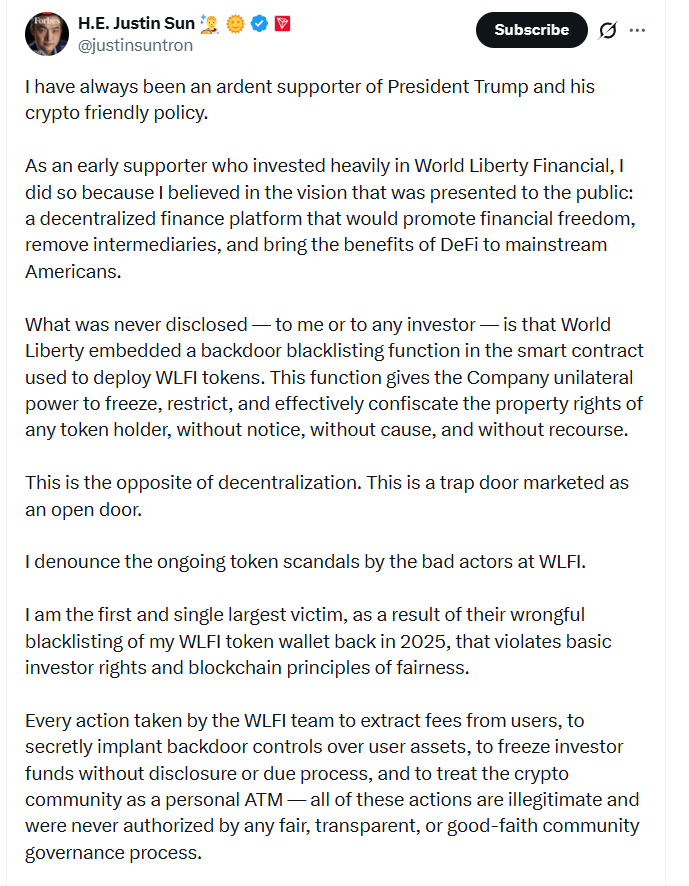
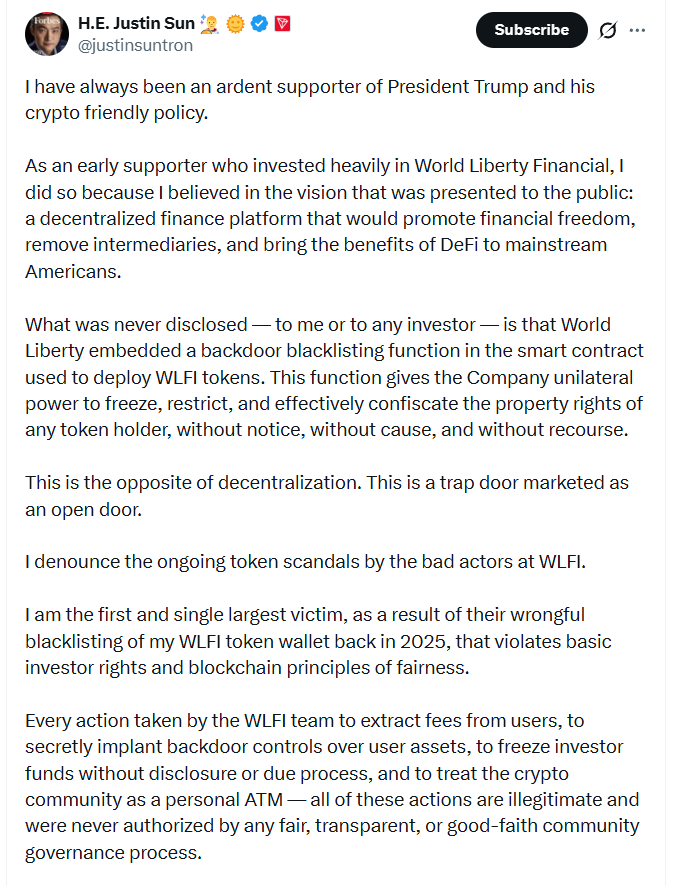
The filing, by Sun and affiliated entities, exposes an admin-controlled blacklist function embedded in WLFI’s smart contract that allowed the team to unilaterally freeze any wallet’s transfers, sales, and protocol interactions without, Sun alleges, disclosing that capability to investors.
The core question this lawsuit raises is not who is legally right. It is whether a governance token that can be frozen by a centralized admin function was ever meaningfully decentralized to begin with – and what that means for every other WLFI holder.
- Filing: Sun sued World Liberty Financial in California federal court, charging breach of contract, fraud, and conversion over frozen WLFI holdings.
- Token freeze details: WLFI froze 540 million of Sun’s unlocked tokens and 2.4 billion locked tokens – holdings that dropped from over $107 million at the September 2025 freeze to an estimated $43–60 million by April 2026.
- Governance dispute: Sun alleges WLFI excluded him from governance activities and that the blacklist function enabling the freeze was never disclosed to investors.
- Market impact: WLFI fell 15% to a record low after Sun publicly accused the project of embedding an undisclosed backdoor on April 12, 2026.
- Sun’s exposure: Sun invested approximately $75 million directly into WLFI – the project’s largest known outside investor – with total exposure to Trump-affiliated crypto ventures reaching $175 million.
- Key watch item: The California court’s ruling on Sun’s motion for immediate token unfreezing will be the first hard signal on whether the blacklist function survives legal scrutiny.
Discover: The best crypto to diversify your portfolio with
What the Token Freeze Actually Reveals About WLFI Crypto Architecture
The dispute is, at its structural core, a governance architecture failure, not a standard investor disagreement.
WLFI’s smart contract contains an admin-controlled blacklist function that enables the project team to freeze any wallet’s ability to transfer, sell, or interact with tokens. Sun claims this capability was not disclosed to investors as required, a material omission for a project marketed as a decentralized governance platform.
The freeze was triggered in September 2025 after Sun transferred roughly $9 million worth of WLFI tokens to external wallets following the governance token launch, a move WLFI characterized as a potential violation of his investor agreement.
The project defended the blacklist as a standard compliance tool comparable to those used in USDT or USDC.
That framing matters, because it concedes the function operates like a centralized stablecoin control mechanism, not a decentralized governance token.
Today, I filed a lawsuit in California federal court against World Liberty Financial to protect my legal rights as a holder of $WLFI tokens.
I have always been—and remain—an ardent supporter of President Trump and his Administration’s efforts to make America crypto friendly.…— H.E. Justin Sun

(@justinsuntron) April 22, 2026
Sun’s lawsuit seeks a court order to unfreeze his holdings, trial-determined damages, and an injunction barring WLFI from burning or otherwise tampering with his tokens.
The allegations, if proven, would indicate that WLFI’s governance token design gives its founding team veto power over any holder’s economic rights, a structural reality that extends well beyond Sun’s individual dispute. Governance disputes and frozen assets remain a documented risk across DeFi projects, as recent protocol-level failures have shown.
Discover: The best pre-launch token sales
The post Justin Sun Sues World Liberty Financial Over WLFI Crypto Token Freeze appeared first on Cryptonews.
Crypto Regulation News,Regulation#Justin #Sun #Sues #World #Liberty #Financial #WLFI #Crypto #Token #Freeze1776881264