
Morgan Stanley’s new Ethereum and Solana exchange-traded products generated roughly $38 million in combined trading volume on their first day, giving the Wall Street firm an immediate presence in two crypto fund markets dominated by earlier entrants.
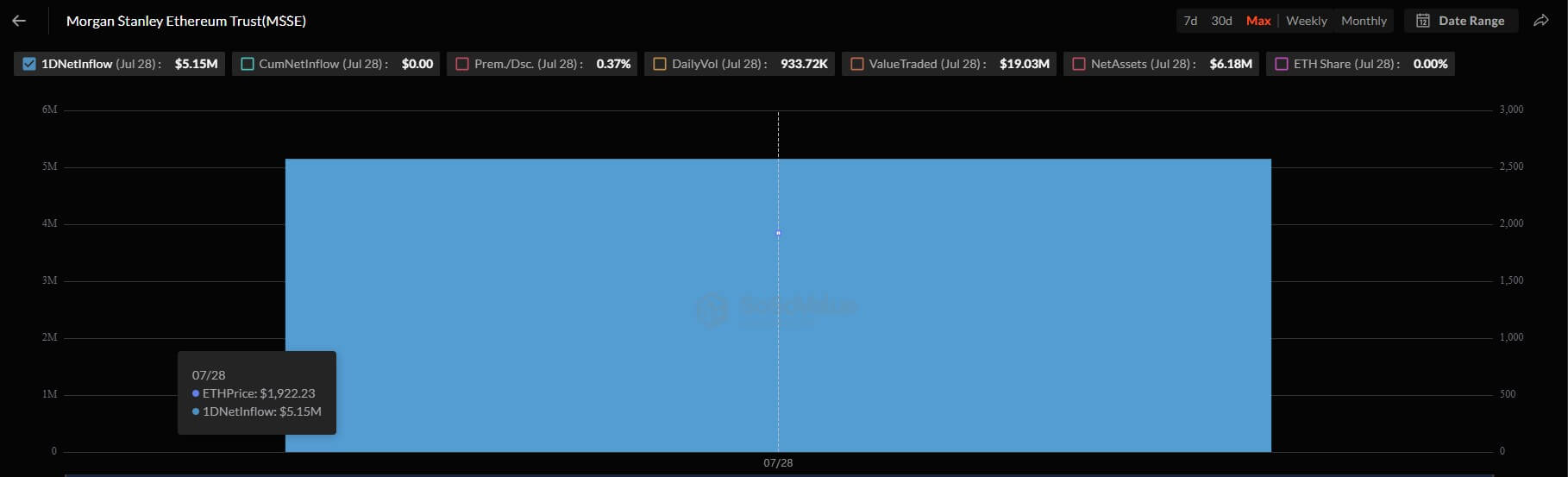
The Morgan Stanley Ethereum Trust (MSSE) recorded 933,715 shares traded Tuesday and attracted $5.15 million of net inflows. The Morgan Stanley Solana Trust (MSOL) traded 951,216 shares, producing roughly $19 million of turnover but no net creations. Each product began trading on NYSE Arca at around $20 per share.
Data from SoSoValue shows that the MSSE’s inflows represented more than a third of the roughly $14.5 million that entered US ETH funds during the session. BlackRock’s staking-enabled ETHB drew $5.9 million, and its larger ETHA product added $3.5 million.
Meanwhile, the Solana market moved in the opposite direction, with the existing fund group losing $18.1 million as investors pulled the entire amount from Bitwise’s BSOL.
The contrasting debuts provide an early test of how much market share Morgan Stanley can capture after entering both categories late. MSSE converted a sizable portion of its first-day trading into new assets, while MSOL drew comparable secondary-market activity during a session when investors were reducing exposure to the broader Solana fund complex.
Morgan Stanley Investment Management launched the two products July 28 as an extension of a crypto lineup that began with the Morgan Stanley Bitcoin Trust in April.
MSBT had accumulated more than $400 million in assets as of press time despite entering a Bitcoin fund market already led by BlackRock and Fidelity.
The new products also push Morgan Stanley beyond simple spot exposure. Both can stake their underlying assets, placing the firm directly into a growing competition over how much yield fund issuers return to investors.
Morgan Stanley undercuts rivals on fees
Morgan Stanley is entering that fight with one of the lowest combinations of management and staking charges available in either market.
MSSE and MSOL each carry a 0.14% annual sponsor fee. Morgan Stanley will also take no direct share of their staking rewards, while custodians and staking providers are expected to receive an aggregate 5% of gross rewards. The remainder is retained by the trusts before distributions and applicable expenses.
That structure undercuts several established competitors.
In Solana, Bitwise’s BSOL charges a 0.20% management fee and passes 6% of staking rewards to service providers. Grayscale’s GSOL charges 0.19% and gives up 7%, while Franklin Templeton’s SOEZ takes 8% of staking rewards. Staking cuts rise to at least 10% at 21Shares, 15% at Fidelity and 25% at VanEck, Farside Investors data show.

The ETH market has a similar spread, Farside data shows. Grayscale’s lower-cost ETH product carries a 0.15% management fee and a 6% staking charge, while BlackRock’s ETHB has a stated 0.25% sponsor fee and gives up 10% of staking rewards.
The staking charges on 21Shares’ TETH and Grayscale’s larger ETHE product stand at 25% and 23%, respectively.

BlackRock temporarily undercuts Morgan Stanley on ETHB’s headline management cost through a waiver that lowers its fee to 0.12% on the first $2.5 billion of assets for 12 months beginning in March. Its standard rate remains 0.25%.
Morgan Stanley’s challenge therefore extends beyond a conventional ETF fee war. For staking products, investor returns also depend on how much of the portfolio participates in the network and how much of the resulting reward is retained by intermediaries.
MSSE plans under normal market conditions to stake between 50% and 80% of its Ethereum holdings. Its prospectus sets 80% as the target maximum while allowing the amount to vary with redemption needs, network withdrawal times and market liquidity.
MSOL is more aggressive. The trust intends to stake as much as 100% of its SOL, while periodically keeping assets unstaked to meet expected redemptions and other liquidity requirements.
Both funds intend to distribute net staking rewards in cash monthly, but at least quarterly. Rewards accrue in ETH or SOL before the trusts sell an equivalent amount of the tokens to fund distributions to shareholders.
That approach gives investors access to staking income through a traditional brokerage product without requiring them to custody tokens or interact directly with validators.
Distribution tests the incumbents’ head start
Despite the lower costs, Morgan Stanley still has a substantial gap to close against funds that have spent months or years accumulating assets and liquidity.
Bitwise’s BSOL has attracted about $892 million of cumulative net inflows, accounting for most of the roughly $1.12 billion accumulated across the Solana products tracked by Farside.
BlackRock’s original ETHA product has drawn about $11.4 billion, while its newer staking-enabled ETHB has already attracted roughly $529 million.
Those balances give the incumbent products deeper trading histories and established investor bases, advantages that a lower fee does not immediately erase.
However, Morgan Stanley brings a different advantage.
Bloomberg Intelligence analyst Eric Balchunas described the new products as the most significant additions to the ETH and Solana ETF markets since their initial launch, citing Morgan Stanley’s size and reach. The firm has almost 16,000 financial advisers overseeing about $2.6 trillion in combined client assets.
Its broader Wealth Management business ended 2025 with $7.4 trillion in client assets and more than 20 million client relationships.
Morgan Stanley has also identified crypto and tokenization among the product capabilities it intends to expand as more customers move between its E*TRADE, workplace and adviser-led channels.
The firm has been building the infrastructure around those ambitions. E*TRADE completed the rollout of direct Bitcoin, Ethereum and SOL trading earlier this month, while Morgan Stanley has also created a referral arrangement with Galaxy Digital that allows eligible wealth clients to convert crypto exposure into shares of spot ETPs.
That distribution network gives MSSE and MSOL a route to investors beyond the crypto-native audience that helped establish many of their competitors.
ETF,Featured,Staking,TradFi,ethereum,Morgan Stanley,Solana,stakingETF,ethereum,Morgan Stanley,Solana,staking#Morgan #Stanley #trillion #client #assets #rockbottom #fees #hijack #Wall #Streets #crypto #boom1785344441