
Bitcoin traders have spent the past month reducing protection against a price decline while the Fed has made its next decision harder to predict.
The Bitcoin options put-to-call open-interest ratio has fallen to approximately 0.52 from 0.76 in late June, meaning about 52 put contracts remain open for every 100 calls. Meanwhile, Fed Funds futures assigned around a 35% probability to a quarter-point rate increase after the implied probability briefly reached 40% on Monday.
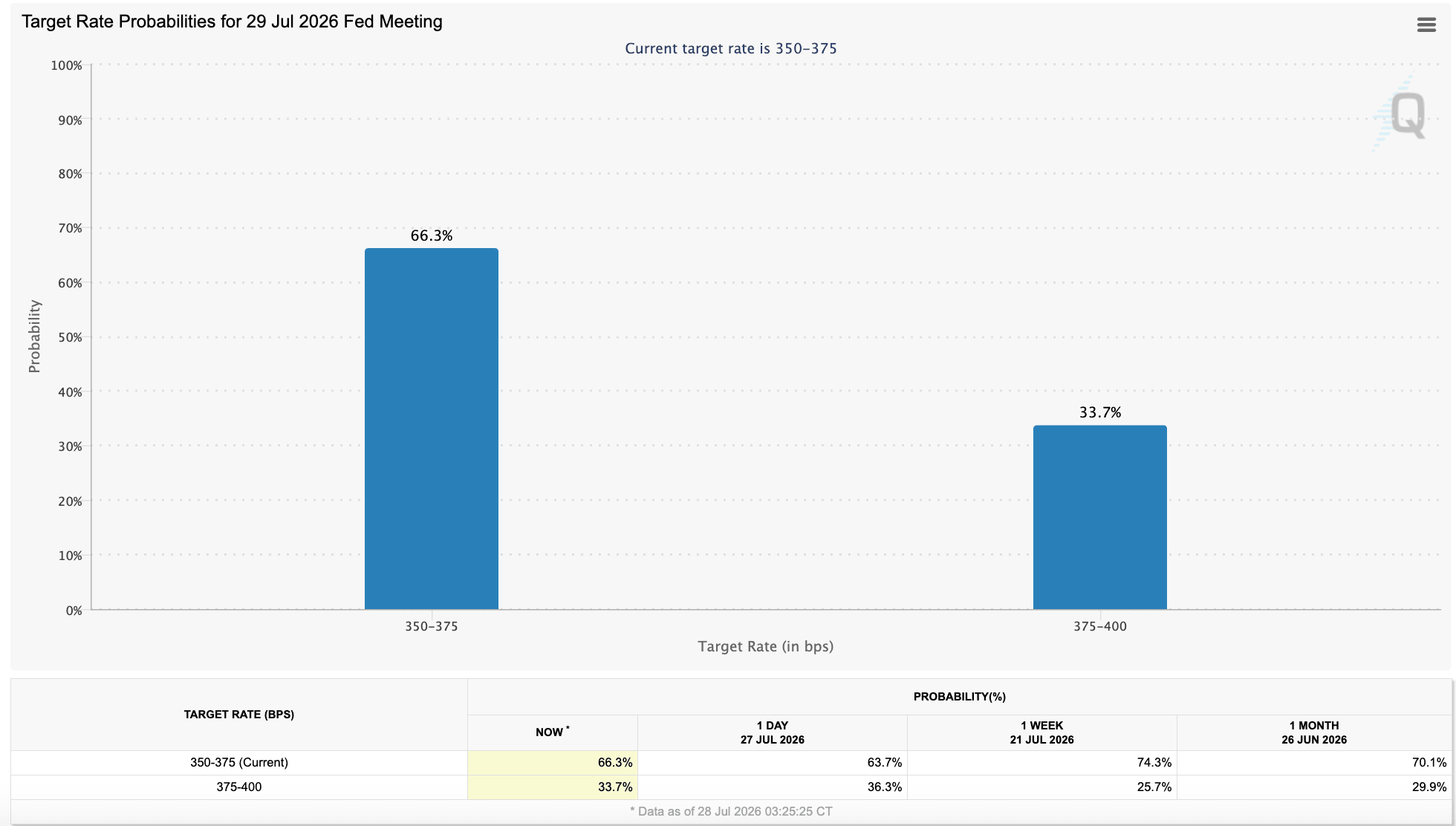
So the two markets are now sending opposing signals. Interest rate traders see an unusually wide range of policy outcomes, while Bitcoin traders are paying less for protection against an immediate decline.
Bitcoin traded near $63,400 on Tuesday as the Fed’s two-day meeting began. HSBC described Wednesday’s outcome as the most uncertain Fed decision in two years and one of the least certain in more than four years, according to Reuters.
The uncertainty reflects Chair Kevin Warsh’s retreat from the forward guidance that previously helped investors narrow the range of likely outcomes before officials voted.
The put-to-call ratio describes the composition of open positions, and it can’t tell us anything about the intention behind each trade. Calls may represent outright bets on higher prices, while puts may serve as insurance, income-generating sales, or parts of larger strategies.
Traders’ willingness to hedge is visible in options pricing. One-week puts still trade at a premium to comparable calls, showing that investors continue to value downside protection. However, that premium, known as put skew, eased to about 9% from nearly 13% on Friday.
This means that traders have become less willing to pay for insurance covering this week’s Fed decision. The move is an extension of a broader July trend, with Deribit analytics showing seven-day Bitcoin skew moving closer to neutral after puts carried an 11-point volatility premium earlier in the month.
The positioning has become more consequential now because Friday’s options expiry contains large call concentrations at $70,000 and $72,000. CryptoSlate previously reported more than 20,000 calls at each strike, including a 20,000-by-20,000 bull call spread.
Bitcoin would need to gain more than 10% from Tuesday’s price to reach $70,000 before those contracts settle on July 31. The holders of those calls therefore need the market to move in the correct direction and travel far enough to offset the options’ rapidly declining time value.
What each Fed outcome could mean for Bitcoin
| Fed outcome | Likely market response | Bitcoin consequence | Options consequence |
|---|---|---|---|
| Quarter-point increase | Short-term Treasury yields and the dollar rise | Tighter financial conditions pressure Bitcoin and other risk assets | Put demand could return quickly, while far-out-of-the-money calls lose value |
| Hold with strict inflation language | Initial relief fades as September remains open | Bitcoin may struggle to sustain a rally while yields remain elevated | Call holders face rapid time decay without a large price move |
| Hold with softer guidance | Yields and the dollar decline | Improved liquidity expectations support risk appetite | The $70,000 and $72,000 calls receive their strongest chance of recovering value |
A quarter-point increase would probably push short-term Treasury yields and the dollar higher, tightening financial conditions for assets that benefit from abundant liquidity. Bitcoin could then face conventional macro selling alongside options-related hedging.
Dealers who have sold downside protection may need to sell Bitcoin futures or spot exposure as prices fall and the sensitivity of their positions changes. That adjustment can reinforce the initial move, particularly if Bitcoin falls through price levels carrying substantial options activity.
A hold accompanied by firm inflation language from the Fed is probably the most complicated outcome. Traders could initially buy Bitcoin as the feared increase disappears, although the relief may fade if Warsh keeps September fully open and Treasury yields stay elevated.
This scenario creates a particular problem for the large July 31 calls. A modest rally would still leave the $70,000 and $72,000 strikes out of reach, while each passing hour reduces the remaining value of the contracts.
A softer hold would offer the easiest and most likely path towards those strikes. If the Fed uses language that acknowledges lower energy prices, weaker hiring, or reduced inflation, the pressure could pull yields and the dollar lower, improving liquidity expectations and encouraging demand for risk assets.
Small changes in the Fed’s language will matter
The decision is expected at 2 p.m. ET Wednesday, followed by Warsh’s press conference at 2:30 p.m. The July meeting includes no new Summary of Economic Projections, which means investors will receive no updated dot plot showing where officials expect rates to finish the year.
The absence of new forecasts puts greater weight on the policy statement, the vote count, and Warsh’s answers during the press conference. Investors will focus on any change to the Fed’s description of inflation, employment, and the balance of risks, along with any indication that September remains open to another increase.
The June projections raised expected 2026 PCE inflation to 3.6% from 2.7% and lifted the median year-end policy rate estimate to 3.8%. Initial jobless claims have since fallen to 187,000, giving policymakers evidence of a resilient labor market even as the pace of hiring remains subdued.
The two-year Treasury yield will provide the fastest indication of whether markets see a stricter policy path. A sustained rise in the dollar would show that financial conditions are tightening beyond the initial announcement.
Within crypto markets, traders should watch Bitcoin’s one-week skew, futures open interest, US spot-market premiums, and spot Bitcoin ETF flows. Rising put premiums would show that investors are rebuilding protection, while falling yields combined with stronger US spot demand would support the expiring upside positions.
Warsh’s communication strategy asks markets to price economic information with fewer signals from policymakers. Bitcoin traders have responded by carrying less immediate insurance into an unusually uncertain decision.
Wednesday will show whether that positioning reflects efficient risk assessment or confidence built during an era when the Fed rarely surprised markets.
Analysis,Derivatives,Featured,Macro,Bitcoin,BTC,fed,federal reserve,hedging,kevin wash,options,options expiryBitcoin,BTC,fed,federal reserve,hedging,kevin wash,options,options expiry#Bitcoin #traders #stripped #crash #protection1785245475