
Robinhood is pushing deeper into crypto infrastructure with the launch of its own blockchain network, tokenized stocks and decentralized lending products, even as one of its fastest-growing revenue opportunities may be forming outside crypto.
On July 1, the brokerage launched the public mainnet for Robinhood Chain at a London event, marking its most direct move yet into onchain financial infrastructure.
The Ethereum layer-2 network, built on Arbitrum, is designed to support tokenized real-world assets, decentralized finance applications and trading activity tied to Robinhood’s expanding global product suite.
The launch gives Robinhood more control over the infrastructure behind its tokenized stock ambitions. Stock Tokens are now available through Robinhood Wallet in more than 120 countries, though access varies by jurisdiction.
The company said eligible users will be able to trade tokenized equities around the clock and use them across decentralized finance applications, including lending pools and collateral for trading.
Robinhood also introduced Robinhood Earn, a decentralized lending product that allows eligible US users to lend USDG, its dollar-backed stablecoin, through a self-custody wallet.
The product offers an estimated 7% annual percentage yield and uses lending infrastructure powered by Morpho, with insurance procured through Lloyd’s of London and RELM for covered losses tied to cyber or smart contract exploits.
The crypto rollout came alongside a broader slate of expansion. The company revealed plans to launch crypto trading in the UK, to make its services available in Canada following its acquisition of WonderFi, and to have received a capital markets services license in Singapore.
These announcements show how Robinhood is trying to turn a retail brokerage into a global trading venue spanning stocks, crypto, tokenized assets, derivatives, decentralized finance and artificial intelligence tools.
Yet the company’s next major revenue surprise may come from event contracts, the prediction-market products that allow users to trade on outcomes in politics, sports, economics and other events.
A crypto launch lands as event contracts accelerate
Robinhood’s blockchain push gives the company a clearer foundation for its tokenized asset strategy at a time when prediction markets are beginning to challenge crypto trading as a source of transaction revenue.
Artemis analyst Crossroads suggests Robinhood’s prediction-market revenue could exceed its crypto revenue as early as the second quarter.
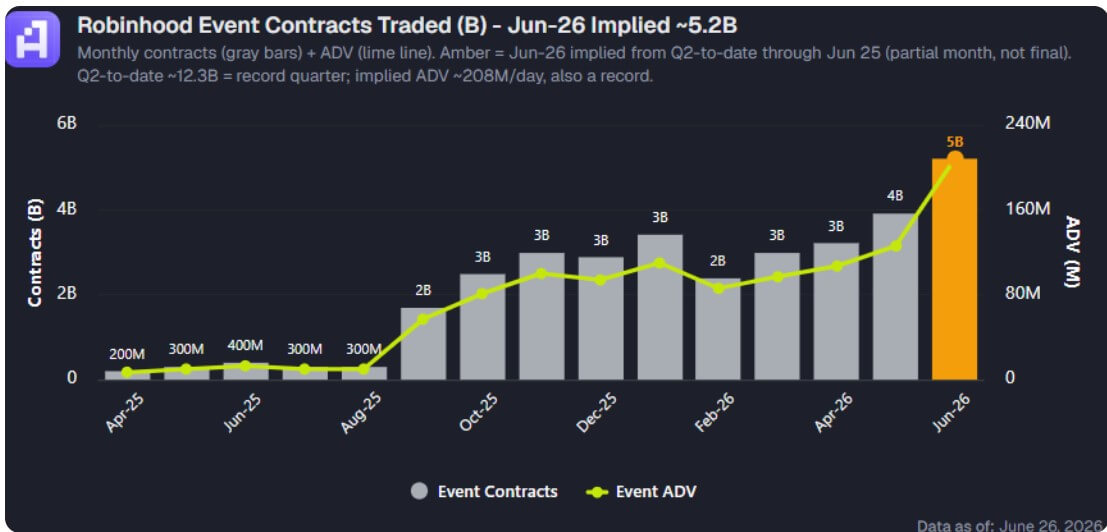
The report cited about 12.3 billion event contracts traded through June 25. At a typical take rate of 1 cent per contract, that would imply at least $123 million in quarterly revenue before the final days of June are included.
That figure would put prediction markets within reach of Robinhood’s first-quarter crypto transaction revenue, when the company reported $134 million.
While crypto volumes showed some improvement in June, they remained under pressure compared with earlier periods, with institutional activity carrying lower take rates than retail trading.
The comparison is not final until Robinhood reports second-quarter earnings. But the estimates point to a shift in how investors may need to view the company.
Indeed, Robinhood has long been treated in part as a retail crypto proxy because trading booms in Bitcoin, Dogecoin, and other digital assets have flowed into its results. A larger contribution from event contracts would make that relationship less direct.
Prediction markets have also grown despite legal and regulatory challenges. Robinhood has offered event contracts through its partnership with Kalshi, one of the leading US platforms in the category.
Chief Executive Officer Vlad Tenev has described the company as near the beginning of a prediction-market cycle, and Robinhood executives have pointed to a $500 million annual revenue run rate.
Sports markets, including World Cup-related activity, have helped the recent surge. That creates a clear durability test. Volumes tied to a major global event can fade after the tournament ends.
Still, Artemis argued that Kalshi’s growth outside sports and Robinhood’s distribution give the business a path beyond one event cycle.
Robinhood is moving from distribution into infrastructure
The more important development for Robinhood may be its attempt to own more of the plumbing behind its products.
That shift is visible in crypto through Robinhood Chain. The network is built to provide developers with a platform for tokenized assets and decentralized finance tools, with integrations from firms including Alchemy, BitGo and Chainlink.
Uniswap is also deploying a dedicated automated market maker on the chain, while Pleiades is deploying a proprietary automated market maker to serve as a trading venue.
The same infrastructure logic is emerging in prediction markets through Rothera, the platform tied to Robinhood and Susquehanna. Rothera is still small compared with Kalshi and Polymarket, and its long-term monetization has not been established.
However, the platform has generated more than $900 million in volume over a recent one-week period, giving Robinhood a potential route to operate more directly in the market rather than relying entirely on third-party venues.
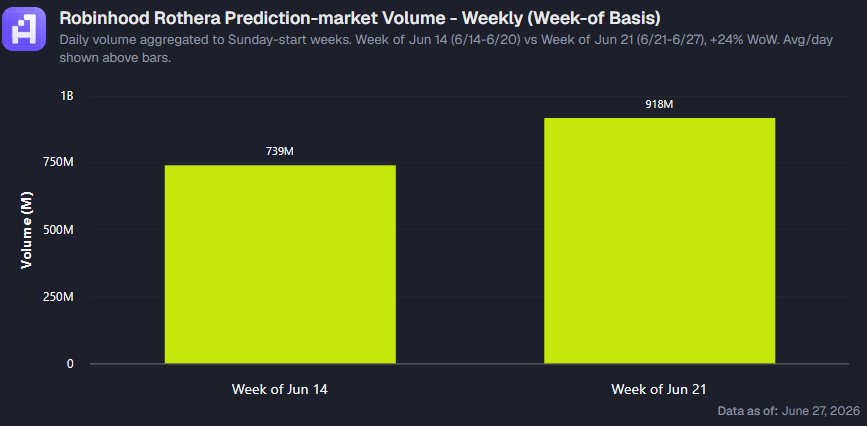
That distinction could become important if Robinhood begins routing more of its own app-based event-contract activity through Rothera. A brokerage that controls the consumer interface and more of the underlying market infrastructure can capture more of the economics, set pricing more aggressively, and use liquidity from one side of the business to strengthen the other.
The strategy resembles the broader approach behind Robinhood Chain. In both cases, Robinhood is trying to move beyond simply offering access to outside markets. It is building or aligning with infrastructure that can sit underneath the trading activity itself.
That does not remove the risks. Rothera currently lacks the scale of the biggest prediction-market platforms. Its recent volume may be partly tied to temporary demand in sports.
Robinhood’s economics could also vary depending on whether trades continue to flow through Kalshi, move to Rothera, or use a mix of both venues.
Moreover, the regulatory path for prediction markets remains unsettled, especially if the category continues to expand beyond narrow financial and sports contracts.
Perpetual futures widen the trading menu
Robinhood’s derivatives expansion in Europe shows that the company is also building a more conventional trading business around advanced products.
The brokerage said commodity, ETF and foreign exchange perpetual futures are being rolled out to eligible European users, adding assets such as gold, silver, QQQ, EUR/USD, WTI, Brent crude and EWY. The products allow up to 10x leverage and trading around the clock.
Robinhood also said Bitstamp by Robinhood launched multi-asset perpetual futures, giving institutional market participants access to FX, equity indices, commodities and crypto from a single pool of capital.
The offering uses a US dollar-settled account with unified collateral management, reference prices from Kaiko Benchmark Indices and matching technology powered by Nasdaq. Bitstamp by Robinhood operates as a MiFID II-authorized multilateral trading facility in Europe.
The expansion gives Robinhood more ways to compete with crypto-native exchanges, traditional brokerages and derivatives venues. It also shows how the company is applying crypto-style trading mechanics, including perpetual futures and 24-hour market access, to traditional asset classes.
That strategy could make Robinhood less dependent on any single cycle. Crypto trading revenue has historically been volatile, rising sharply during retail-led rallies and falling when token prices and volumes weaken.
Perpetual futures, prediction markets, tokenized stocks, and lending products could provide the company with additional revenue streams with distinct demand drivers.
AI tools push the platform closer to automated trading
Robinhood is also preparing to bring more automation into crypto trading through Agentic Accounts for eligible US users.
The tool will allow users to connect AI models to Robinhood’s trading infrastructure through its Trading MCP. The company said users will retain control over the amount of capital allocated and the safety limits applied to the strategy, while AI agents can scan data and execute trades within those parameters.
Robinhood has already introduced agentic trading for equities and options in the US. Extending the tool to crypto adds another layer to its plan to combine retail access, automation and multi-asset trading within a single platform.
The company framed the product as a way to give retail traders access to capabilities more commonly used by professional firms.
However, the risks are also clear. Automated trading tools can magnify poor strategy design, weak risk controls and sudden market moves, particularly in crypto markets where liquidity and volatility can shift quickly.
The AI launch fits with Robinhood’s wider effort to make the platform more active, more global and more embedded in users’ financial lives. The same event included a Guinness World Records demonstration in which an AI agent used a Robinhood-branded credit card to purchase items for attendees.
For investors, the test is whether these products can create durable revenue rather than periodic bursts tied to market cycles, product launches, or major events.
Exchanges,Featured,Market,Technology,Tokenization,Trading,ethereum,Prediction Market,Robinhood,Robinhood chainethereum,Prediction Market,Robinhood,Robinhood chain#Robinhoods #expanding #crypto #bet #meets #fastermoving #prediction #market #boom1782997675