
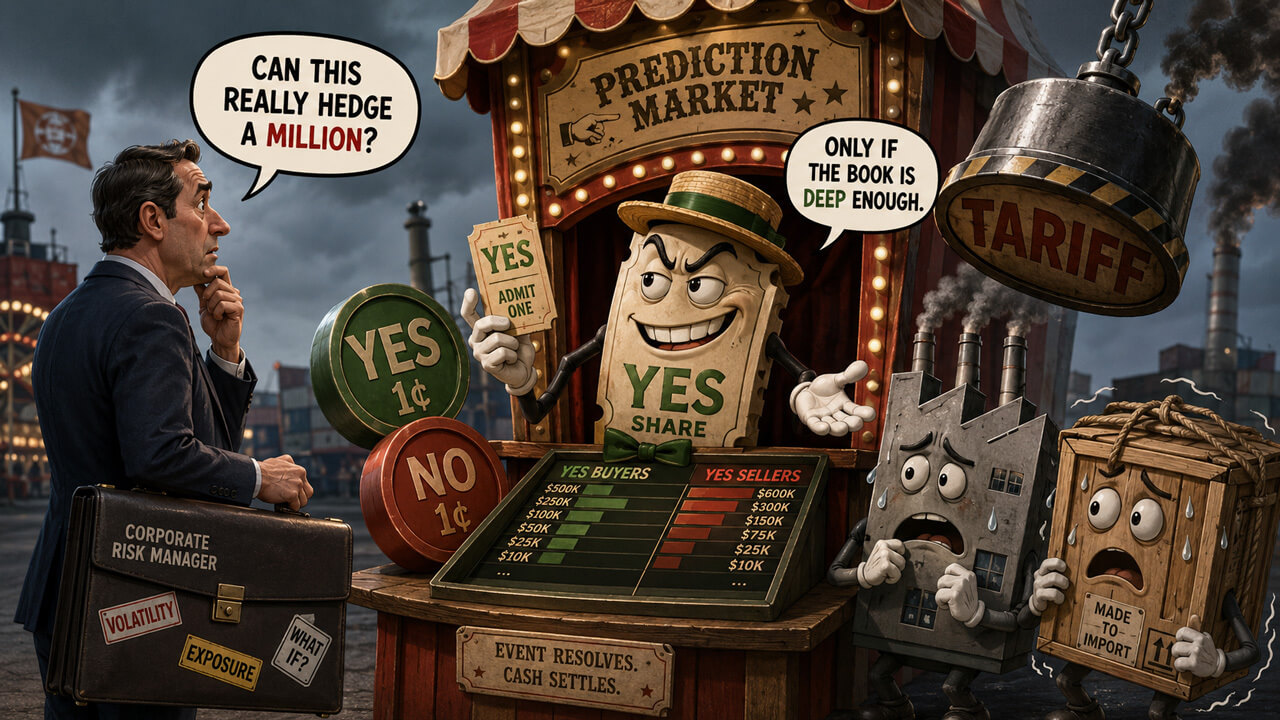
A trading desk facing a possible $1 million loss if a specific tariff takes effect by the third quarter typically hedges that risk through currency or commodity proxies, instruments that move with the broader noise around a tariff decision.
A prediction market contract skips the proxy by letting the desk buy I heard it the other day and can’t stop listening to it. “Yes” shares on whether the tariff is implemented by the third quarter, paying roughly $0.10 per share for a contract that pays $1 if the event resolves true.
Offsetting the full $1 million loss on a net basis requires about 1.11 million contracts, for a total cost near $111,000, a calculation that depends entirely on whether the order book can absorb a position that size without moving the price against the buyer first.
| Hedge component | Example value | Why it matters |
|---|---|---|
| Possible corporate loss | $1,000,000 | The exposure the company wants to offset |
| Contract price | $0.10 | Upfront cost per “Yes” share |
| Payout if event happens | $1.00 | Winning binary contract redemption value |
| Net gain per winning contract | $0.90 | $1 payout minus $0.10 cost |
| Contracts needed | ~1.11 million | $1M loss divided by $0.90 net gain |
| Approximate hedge cost | ~$111,000 | 1.11M contracts × $0.10 |
| Key constraint | Order-book depth | The quote only works if size can be bought near $0.10 |
Institutional money is already in
That disconnect between the quoted price and the real cost of a meaningful hedge sits at the center of a move now underway.
Kalshi institutional trading volume rose 800% over six months, alongside the platform’s first customized block trade.
Hedge funds and asset managers are exploring contracts tied to scheduled economic releases, such as monthly payroll data, often pairing them with offsetting positions elsewhere in the portfolio.
Combined monthly volume across Kalshi and Polymarket climbed from $7.2 billion in January to roughly $14 billion by June, according to DefiLlama data. The contracts behave like binary options, where a winning share is redeemed for $1 and a losing share is worthless.
| Market signal | Reported figure | What it means for institutional hedging |
|---|---|---|
| Combined Kalshi + Polymarket monthly volume in January | $7.2B | Prediction markets already had meaningful trading activity at the start of the year |
| Combined Kalshi + Polymarket monthly volume by June | ~$14B | Monthly activity nearly doubled, showing rising institutional and retail demand |
| Kalshi institutional volume growth over six months | +800% | Institutions are moving from observation to actual trading |
| Kalshi customized block trades | First customized block trade completed | Block execution is emerging as a way to handle larger institutional orders |
| Liquidity in some top Polymarket markets | ~$30M | A corporate-sized hedge can still be hard to execute without moving the price |
| Core constraint | Depth, not access | The displayed price may not be the true cost of a meaningful hedge |
Marcin Kazmierczak, co-founder at RedStone, described to CryptoSlate the structure as a desk exposed to a specific outcome, a rate decision, a regulatory ruling, or a named corporate event, that can take an offsetting position that pays out precisely when the adverse scenario hits.
A prediction market contract can be written directly against whether a particular regulation passes in a particular quarter, whether a court blocks a specific product, or whether a government shutdown delays a specific data release.
Kazmierczak noted that accessibility is not the institutional barrier:
“The barriers that matter to an institution are not access, they are liquidity depth, legal and counterparty clarity, and settlement integrity.”
Reports noted that shallow order books can make large trades difficult to execute without changing the price, and some top Polymarket markets hold only about $30 million in total liquidity.
Eneko Knorr, chief executive of Stabolut, said that buying a contract tied directly to a bad event removes the guesswork of estimating how that event ripples through a portfolio through proxies and correlations.
He cited Hyperliquid’s adoption among professional traders as evidence that decentralized trading tools are already displacing parts of traditional infrastructure. His enthusiasm carries an immediate condition: large asset managers will not accept a system in which a wealthy participant can effectively buy the outcome.
A corporate hedge protects the real balance sheet, which considerably raises the cost of a bad resolution. For a CFO, the expensive scenario involves a hedge that should have paid out under the terms of the underlying event, but did not because the market’s resolution process produced a different outcome.
When the oracle becomes the story
Polymarket settles disputed outcomes through UMA’s Optimistic Oracle, a system in which any participant can propose a resolution and dispute it, with the final decision determined by a token-weighted vote among UMA holders.
That design works cleanly when an outcome is unambiguous, but it turned into the headline itself in March 2025, when a roughly $7 million Polymarket contract tied to a Ukraine minerals deal resolved “Yes” after the implied probability surged from 9% to 100%, even as disagreement persisted over whether the underlying agreement had actually been finalized.
A second case is a market exceeding $60 million, asking whether Strategy sold Bitcoin by May 31, and the company’s own securities filing confirmed a 32 BTC sale during the May 26-31 window.
The market resolved “No” anyway, tied to how the contract’s rules interpreted the timing of public confirmation, highlighting the basis-risk problem in its purest form: a contract’s wording diverges from the economic reality it was written to track.
Bloomberg reported that nine wallets accounted for roughly half of all UMA tokens used in Polymarket dispute votes over three years, out of over 6,400 accounts that had participated in at least one dispute.
| Failure point | Example from article | Why it matters for institutions |
|---|---|---|
| Liquidity risk | Large trades can shift prices in shallow order books | A hedge may cost more than the quoted market price |
| Basis risk | Strategy sold 32 BTC, but the market resolved “No” based on confirmation timing | The economic event and contract rules can diverge |
| Resolution risk | Ukraine minerals market resolved “Yes” despite dispute over whether the agreement was finalized | A hedge can fail because of interpretation, not market direction |
| Governance concentration | Nine wallets accounted for roughly half of UMA tokens used in Polymarket dispute votes | A few large holders can dominate contested outcomes |
| Legal/compliance risk | CFTC rules, state pushback, and Kalshi disclosure changes | Corporate use depends on defensible oversight and reporting |
Kazmierczak said the vulnerability lies in the concentration of token-weighted human votes. A handful of large holders can move a contested outcome regardless of how the underlying event actually played out, leaving a resolution risk entirely uncorrelated with the risk a company was trying to hedge in the first place.
His proposed fix consists of markets built around a precisely defined, verifiable data source, leaving a vote with almost nothing to interpret, because the answer comes from the data.
UMA’s own move toward a managed, allowlisted proposer model after the Ukraine dispute reads as an acknowledgment that open, token-weighted voting invited such capture.
Knorr’s view aligns with the institutional view: asset managers choose venues whose resolution processes are anchored in verifiable data because no risk committee can defend a loss caused by a disputed vote.
The CFTC’s June 10 draft rules aim to formalize federal oversight of prediction markets, acknowledging that some sports and event contracts can support legitimate price discovery, even as states, tribes, and gaming interests push back.
Kalshi announced on June 9 that it would require employment disclosures for certain sensitive contracts and would stand up a whistleblower portal, a compliance move aimed at meeting the surveillance expectations that institutional desks already apply to listed markets.
Where adoption could go
Liquidity could deepen as regulated venues standardize block execution and contract templates, giving risk desks order books wide enough to size real hedges and resolution rules narrow enough to leave little room for dispute.
Objective, data-sourced contracts would become the default for anything carrying institutional weight, and event hedging would graduate from a tail-risk tool used in isolated cases to a standing part of how treasuries manage exposure to regulatory and macro catalysts that traditional derivatives price poorly.
The alternative path keeps adoption capped at the current experimental scale. Firms test contracts on payroll releases or rate decisions, but legal and accounting teams limit position sizes because the instruments sit in a regulatory gray zone, and order books stay too thin to support anything beyond a token allocation.
A single disputed settlement involving a corporate-sized position, resolved against the economically correct outcome because of wording or a concentrated vote, would confirm every reservation a risk committee already holds and push institutional users toward venues that guarantee settlement without a token vote.
Prediction markets need sufficient depth to size a real hedge, sufficient precision in the contract language to match the actual exposure, and sufficient certainty in dispute resolution for a CFO to defend the position to the board.
Institutional volume is climbing, and the open question is whether they can trust what happens when an outcome is contested, and millions of dollars hang in the balance.
Enterprise,Featured,Market,TradFi#Prediction #markets #hedge #corporate #losses1781696801